How to clean laminate and veneer furniture
How to clean laminate and veneer furniture? A YES/NO table for 12 household products, based on EGGER, Kronospan and oil makers. Check before you wash a front.
Autor: Amussim editorial team
Opublikowano:
Ostatnia aktualizacja:
23 min read
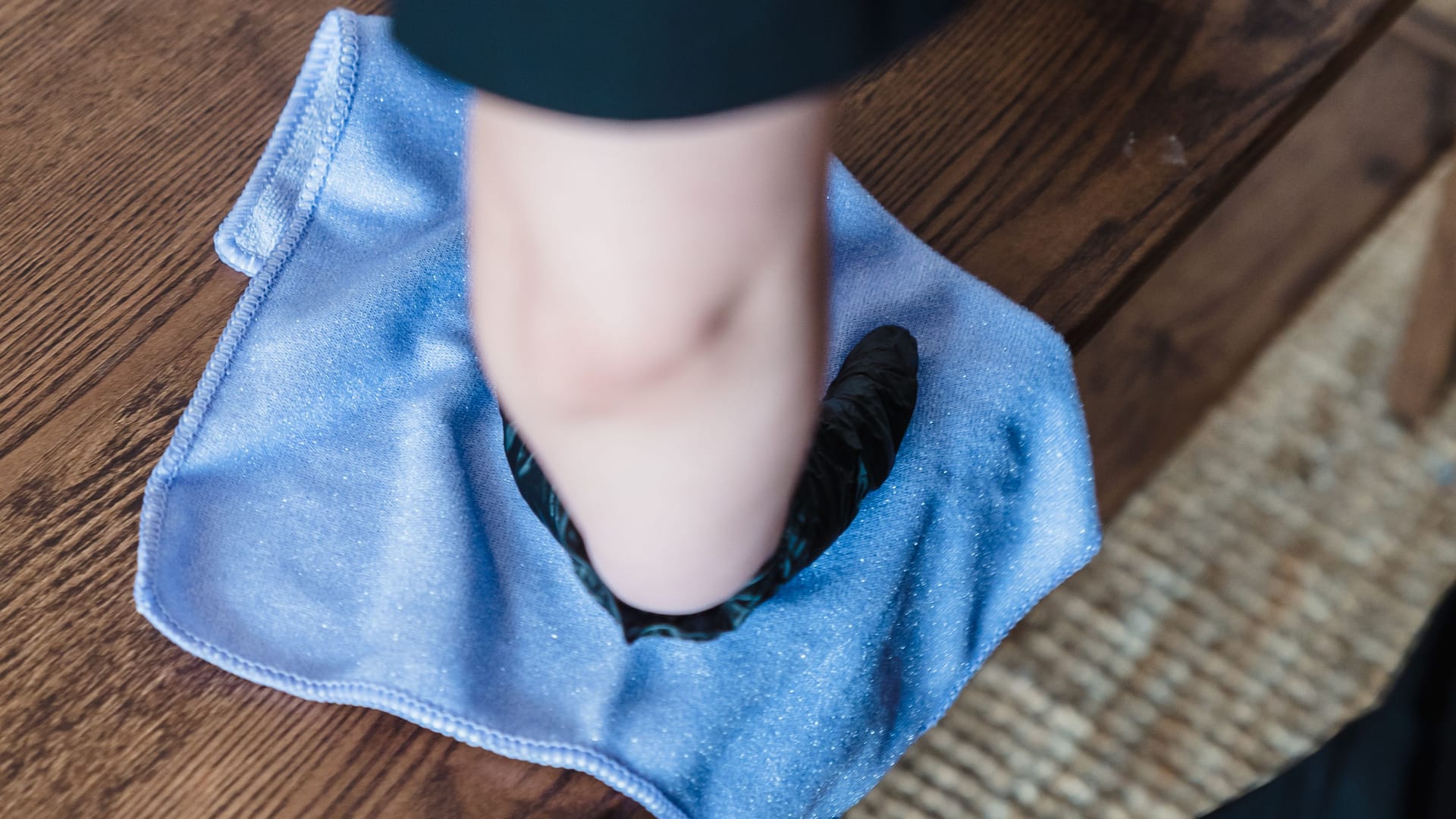
How to clean laminate and veneer furniture? Wash laminate with warm water and a mild cleaner, then dry it. On oiled veneer, wipe only with a damp cloth day to day. A window cleaner that EGGER allows on laminate can harm oiled wood if it contains ammonia. Laminate furniture has a hard, sealed surface: EGGER and Kronospan allow warm water with a mild cleaner, and EGGER also allows window cleaner. Oiled veneer is natural wood saturated with oil, so the rules are different. To avoid dulling a front or washing off the oil, start with the table below.
We did not run our own test of these products. Every rating rests on instructions from board makers (EGGER, Kronospan), the FENIX laminate maker, furniture makers (TEAM 7, Fritz Hansen) and wood oil makers (Rubio Monocoat). Three things are ours: the comparison of 12 products across three finishes, the list of points where the manufacturers disagree, and the "if..., then..." scenarios that follow from it. All of it is in the first section, together with a cheat sheet you can print.
YES/NO table: how to clean laminate and veneer furniture
Wash laminate with warm water, a mild cleaner and a soft cloth, then dry it; EGGER also allows window cleaner. Oiled veneer calls for more caution: TEAM 7 says not to use cleaning products on it, and Rubio Monocoat recommends only plain water and its own products. Neither EGGER nor Kronospan allows scouring powders. EGGER allows a liquid cleaner with the finest polishing chalk only as an exception, and not on high-gloss surfaces.
If you are still choosing a decor and easy cleaning matters to you, also read how to judge a decor sample in your own light. We are preparing a comparison of laminated board and veneer as a separate article.
How to read the ratings (the same marks appear on the printable cheat sheet):
- ✓ YES: the manufacturer explicitly recommends it.
- ! WITH CARE: spot use only, short contact, or the sources differ.
- ✗ NO: the manufacturer advises against it or warns of damage.
- ✗ NO*: the manufacturer recommends only other products.
- ? NO DATA: the sources say nothing, so do not use it.
| Product | Laminated board | Oiled veneer | Lacquered veneer | Sources |
|---|---|---|---|---|
| 1. Water + washing-up liquid (mild detergent) | ✓ YES | ! WITH CARE: water, detergent in spots | ✓ YES | 1, 2 · oil: 4, 5, 6 · lacquer: 5 |
| 2. Vinegar (diluted with water) | ! WITH CARE: EGGER: 10%, briefly | ✗ NO* | ✓ YES: mild solution | 1, 2 · lacquer: 5 |
| 3. Window cleaner (with alcohol or ammonia) | ! WITH CARE: only EGGER recommends it | ✗ NO: ammonia harms the wood | ✓ YES: for fingerprints | 1, 2 · oil and lacquer: 5 |
| 4. Methylated spirit, alcohol (isopropyl: not in the sources) | ! WITH CARE: spirit, only EGGER | ! WITH CARE: alcohol only for ink | ✓ YES: spirit for fingerprints | 1, 5 |
| 5. Acetone (or nail polish remover) | ! WITH CARE: EGGER or FENIX, not on the edge banding | ✗ NO* | ? NO DATA | 1, 3 |
| 6. Scouring cream, paste, powder | ✗ NO: EGGER exception, rarely | ✗ NO* | ✗ NO | 1, 2, 3 · wood: 5 |
| 7. Melamine sponge | ✗ NO: FENIX exception | ✗ NO* | ? NO DATA | 1, 3 |
| 8. Microfibre cloth | ✓ YES: for drying | ! WITH CARE: the sources differ | ? NO DATA | 1, 2 · oil: 4, 6 |
| 9. Silicone, shine spray (or furniture polish) | ✗ NO | ✗ NO* | ✗ NO | 1 · oil: 4, 6 · lacquer: 5 |
| 10. Steam cleaner | ✗ NO | ✗ NO* | ? NO DATA | 1, 2 · oil: 4, 6 |
| 11. Wet wipes | ? NO DATA: use a paper towel instead | ✗ NO* | ? NO DATA | 1 |
| 12. Wood wax or oil | ✗ NO | ✓ YES: an oil that matches the finish | ? NO DATA: ban on polishes (Fritz Hansen) | 1 · oil: 4, 5, 6 · lacquer: 5 |
The numbers in the "Sources" column match the entries in the list of sources at the end of the article.
The reasoning behind each rating, row by row
- Water + washing-up liquid: EGGER and Kronospan: warm water with a mild cleaner. Oil: the sources differ. TEAM 7 says no cleaning products, Rubio Monocoat only its own products, Fritz Hansen soap and water before oiling and foam from a mild detergent for ink. Lacquer: Fritz Hansen, water with an all-purpose cleaner.
- Vinegar: EGGER: 10% acid, briefly, for limescale. Kronospan: bans strong acids, does not mention vinegar. Lacquer: Fritz Hansen, a mild vinegar solution.
- Window cleaner: EGGER: "such as window cleaner"; Kronospan does not mention it. Fritz Hansen: ammonia harms wood; on lacquer, window cleaner for fingerprints.
- Methylated spirit, alcohol: nobody mentions isopropyl alcohol. EGGER: spirit for wax and lacquers, and solvents leave streaks. Fritz Hansen: alcohol for ink (oil); spirit or window cleaner for fingerprints (lacquer).
- Acetone: EGGER: acetone or nail polish remover for wax, lacquers and glues; on edge banding only heavily diluted. FENIX: acetone is safe for FENIX. Kronospan and the wood sources do not mention it.
- Scouring cream, paste, powder: EGGER: cleaners without abrasive ingredients, never scouring powders; as a rare exception, liquid cleaners with the finest polishing chalk for stubborn dirt, not on high-gloss surfaces. Kronospan: bans powders and scouring pads. FENIX: no abrasive cream. Fritz Hansen: steel wool harms wood, and abrasives never go on lacquer.
- Melamine sponge: EGGER: with strong rubbing it leaves shiny patches, sometimes permanent. FENIX: a damp sponge for tougher stains.
- Microfibre cloth: EGGER and Kronospan: dry with microfibre. Rubio Monocoat: microfibre with its spray. TEAM 7: cotton; a copy of the instructions held by a furniture shop excludes microfibre.
- Silicone, shine spray: EGGER: no polishes, waxes or greasing agents. TEAM 7 and Rubio Monocoat do not provide for them. Fritz Hansen: never polishes on lacquer.
- Steam cleaner: Kronospan: "absolutely not advisable". EGGER: not recommended. Oil: TEAM 7 and Rubio Monocoat say only a damp cloth; the copy of the TEAM 7 instructions excludes steam cleaners.
- Wet wipes: nobody mentions them. EGGER allows dry or damp paper tissues and bans greasing agents.
- Wood wax or oil: EGGER: no waxes. TEAM 7, Fritz Hansen and Rubio Monocoat refresh oil with oil. Fritz Hansen bans polishes on lacquer and does not mention wax or oil for it.
We did not find any manufacturer instructions for veneer itself, so for veneer we apply the recommendations for oiled and lacquered wood. NO* rests on two statements: TEAM 7 says not to use cleaning products on oil, and Rubio Monocoat calls its two products the only recommended ones. The exception is water with a mild detergent: Fritz Hansen uses it before oiling and in spots on ink, which is why that row is rated WITH CARE.
Printable cheat sheet: YES/NO for the fridge
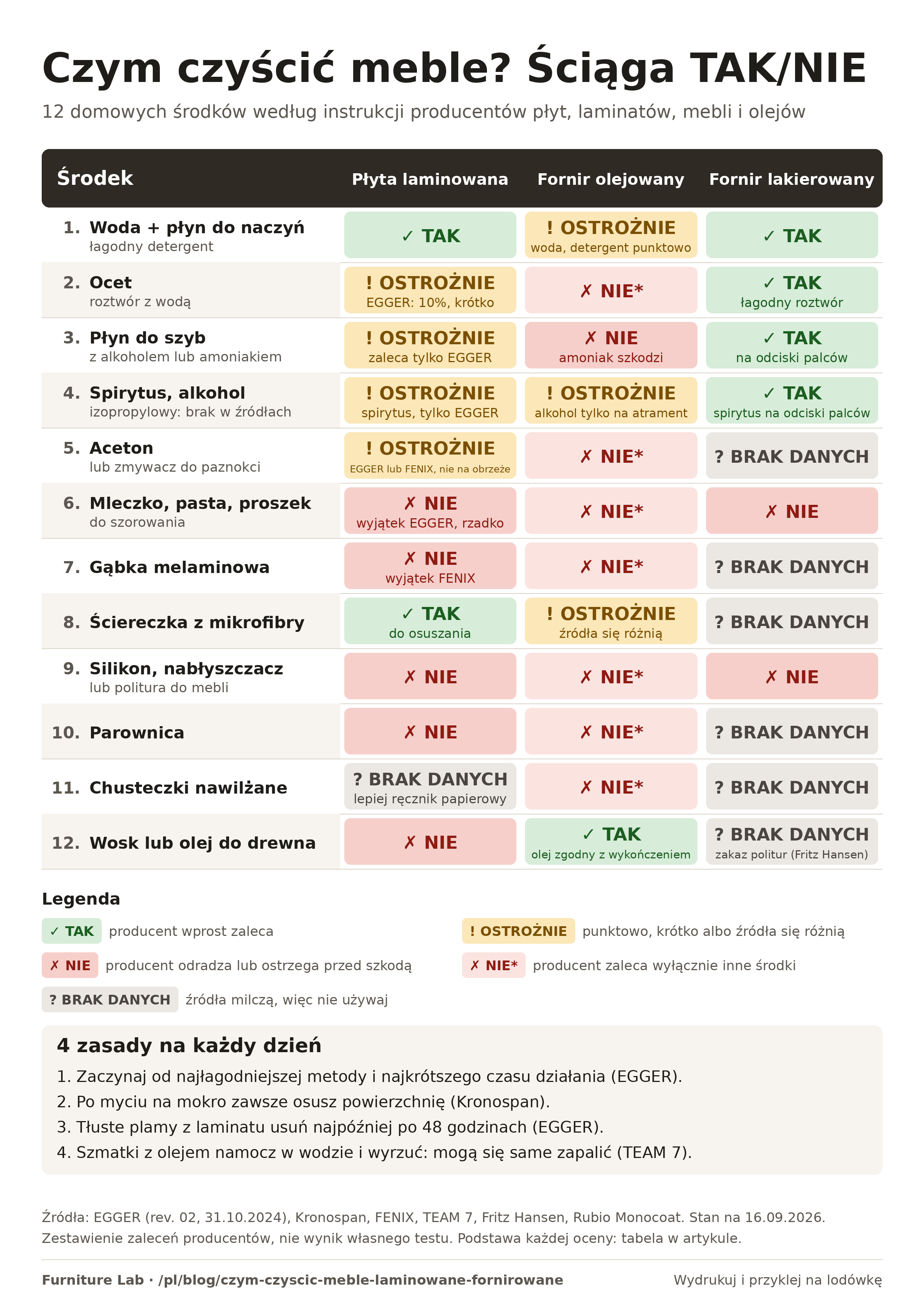
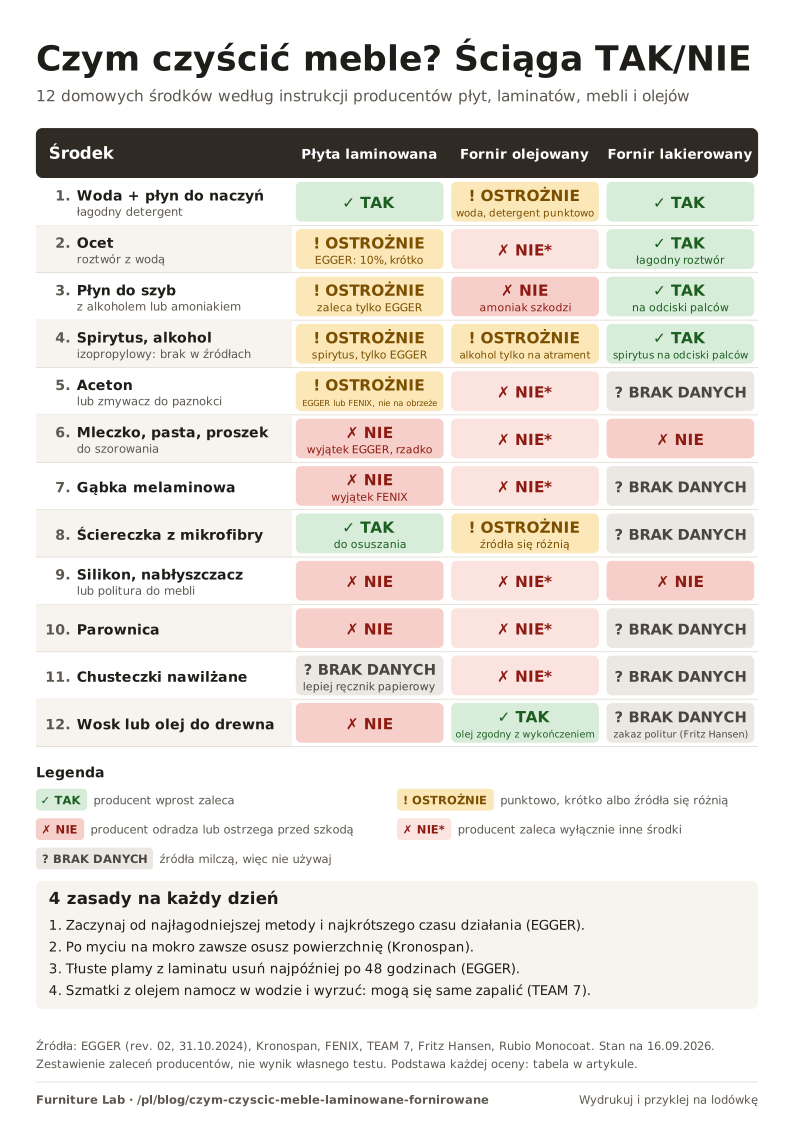
We put the whole table on one A4 page, with the same ratings and notes as above. Besides colour, every rating has a symbol and a word (✓ YES, ! WITH CARE, ✗ NO, ? NO DATA), so you can read it from a black-and-white printout too. At the bottom are four rules that apply whatever the product.
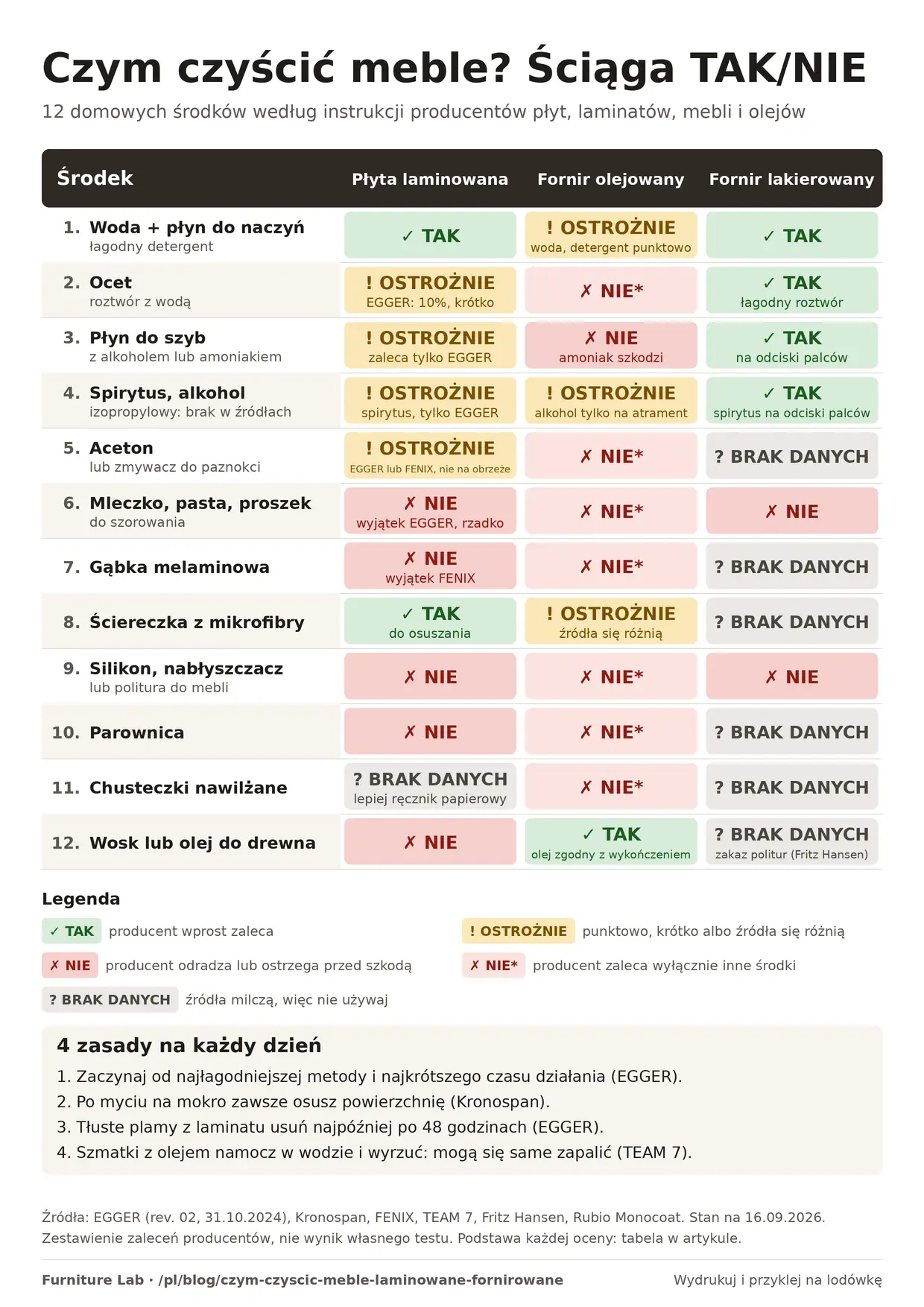
A4 cheat sheet to print: 12 products for laminate and veneer according to the manufacturers' instructions, as of 16 September 2026. Click to download the PDF.
Download the cheat sheet: A4 PDF · PNG, 300 dpi · SVG (vector).
Where the manufacturers' instructions differ
The instructions cover different materials, so they do not always agree. Here are five disagreements. We did not find them compared in the five top-ranking Polish guides we reviewed before writing this text.
- Melamine sponge. EGGER warns that with strong rubbing it leaves shiny patches on the board. FENIX allows a damp sponge on tougher stains, but states that similar matt surfaces are not equally resistant. Conclusion: melamine sponge only on FENIX.
- Washing powder. EGGER lists it dissolved in warm water; Kronospan has it on the list of bans. Conclusion: choose a liquid or soap.
- Acid. EGGER allows 10% acetic or citric acid briefly on limescale; Kronospan bans strong acids. Conclusion: vinegar only on EGGER board, after you check the concentration on the label.
- Microfibre. On laminate, EGGER and Kronospan recommend it for drying. On oiled wood, Rubio Monocoat cleans with it, TEAM 7 names a cotton cloth, and a copy of the TEAM 7 instructions provided by a furniture shop excludes microfibre. Conclusion: cotton is safer on oil.
- Acetone. EGGER and FENIX allow it in spots, and EGGER near edge banding only heavily diluted. The recommendations for oiled wood do not mention acetone. Conclusion: acetone only on EGGER or FENIX laminate.
What follows: 4 "if..., then..." scenarios
This is our conclusion from comparing the instructions, not a recommendation from any manufacturer.
- If you do not know who made the board, stick to what EGGER and Kronospan have in common: warm, not hot, water, a mild cleaner, a soft cloth and drying. Skip everything that one of them bans or does not mention: powders, vinegar and other acids, solvents, window cleaner, polishes and steam cleaners. That is why window cleaner, vinegar and solvents are rated WITH CARE in the table, with a note on which manufacturer allows them.
- If a front is matt and you do not know whether it is anti-fingerprint, treat it like ordinary laminate. The FENIX instruction that allows a melamine sponge and acetone applies to FENIX only.
- If a piece is veneered and you do not know whether it is oiled or lacquered, apply the stricter rules for oil: a slightly damp cotton cloth, no cleaning products. Do not oil it until you know the finish, because none of the oil sources covers lacquer.
- If a stain does not come off with soapy water, on EGGER board you can use spirit or acetone in spots, away from the edge banding. On a board of unknown make that is already a risk, because Kronospan does not mention solvents (see scenario 1). On oiled veneer, keep solvents for ink; Fritz Hansen removes liquids and wax with a sponge moistened with oil.
How to care for laminated board furniture
How to clean laminate furniture day to day? Usually it is enough to wipe the board with a soft cloth or sponge, dry or wet, and then dry it. Kronospan recommends warm, not hot, water, because cold water can leave streaks. For heavier dirt, add a mild cleaner without abrasive or colouring ingredients.
Laminated (melamine) board is a wood-based panel, most often chipboard, covered with decorative paper saturated with melamine resin. EGGER describes such a surface as resistant, hygienic and compact, so according to the manufacturer it needs no special care. It does not need oiling, and EGGER explicitly bans waxes.
EGGER advises always starting with the mildest method and the shortest contact time. Greasy dirt must be removed as soon as possible, at the latest after two days, because later the surface may be damaged.
At Furniture Lab, laminated board comes in five decors: Dąb Halifax naturalny (natural Halifax oak), Biały mat (matt white), Szary kaszmir (cashmere grey), Beton ciemny (dark concrete) and Orzech Lincoln (Lincoln walnut). If you know who made the board in your furniture, that manufacturer's instructions take precedence over this comparison.
Cleaning matt fronts and fingerprints
According to Kronospan, matt boards can be more prone to greasy stains. The manufacturer says to remove them as soon as possible and to clean the matt surface only with soft materials. EGGER writes in general terms, for all its surfaces, that streaks most often come from organic solvents, cold water and cloths used many times.
You can remove fingerprints from matt furniture like this (based on the EGGER and Kronospan instructions):
- Soak a soft cloth in warm water with a drop of mild cleaner and wring it out well.
- Wipe the dirty spot without rubbing hard.
- Rinse with clean water.
- Dry with an absorbent microfibre cloth.
- Use a clean cloth for the next front.
What to avoid on anti-fingerprint fronts
An anti-fingerprint front is a matt surface on which finger marks are less visible. EGGER gives this property to lacquer-based surfaces from the PerfectSense family (including Premium Matt and Topmatt), and FENIX describes its nanotech laminate this way. Ordinary Eurodekor laminated boards are not on this EGGER list, so a matt decor alone does not mean anti-fingerprint.
What to avoid:
- Polishes, wax-based products and greasing plastic cleaners. EGGER notes that the anti-fingerprint effect works only if they were never used.
- Rough cloths and melamine sponges on EGGER boards. With strong rubbing they can leave shiny patches.
- Transferring the FENIX instructions to other matt surfaces. FENIX allows a melamine sponge and acetone, but those recommendations apply only to its own material.
How to clean high-gloss laminate furniture
On a high-gloss front, keep to the same basics: water with a mild cleaner and a soft cloth. The difference concerns stubborn dirt in groups 2 to 4 of the EGGER table (limescale and rust, wax and crayon, bacterial contamination). For these the manufacturer allows rarely used liquid cleaners with the finest polishing chalk, or mild bleaches, but explicitly rules them out on high-gloss surfaces. For bacterial contamination (group 4), EGGER also allows a disinfectant after washing, in line with the regulations. In its general rules, however, EGGER lists bleaches among the products not to use, and Kronospan bans them outright. It is safer not to use them.
Wood structure: clean along the grain
EGGER and Kronospan recommend cleaning the board along the direction of the surface structure. According to EGGER, even a deep structure can be cleaned without trouble if you follow the instructions. For ordinary dirt, EGGER allows a soft brush.
Edge banding and joints
Stricter rules apply on edge banding. EGGER writes that products containing solvents may be used on edge banding only heavily diluted, and any product must be washed off the edge banding straight away. Kronospan reminds you to dry the surface with a paper towel or microfibre cloth after wet wiping.
We compare edge banding thicknesses and materials in a cheat sheet on which edge banding suits which place in a piece of furniture. If an edge has already swollen or chipped, see what to do about swollen board and chips.
How to clean veneer furniture: oiled and lacquered
Clean oiled veneer with a slightly damp, non-dripping cloth: according to Rubio Monocoat, plain water is enough for regular cleaning. Lacquered veneer tolerates more. For lacquered wood, Fritz Hansen allows hot water with an all-purpose cleaner, soap flakes (a spoonful per litre of lukewarm water) and a mild vinegar solution.
Veneer is a thin sheet of natural wood glued to a board. Oiled veneer is protected by oil that soaks into the wood, and lacquered veneer by a coat of lacquer. Furniture Lab offers these veneers: Dąb olejowany (oiled oak), Orzech amerykański (American walnut, oiled) and Jesion bielony (bleached ash).
Oiled veneer day to day
In its care recommendations, TEAM 7 says to remove dust and dirt with a slightly damp cotton cloth and not to use cleaning products, so as not to damage the oiled surface. The copy of the TEAM 7 instructions provided by a furniture shop adds bans on microfibre, degreasing household products and steam cleaners. We could not open the official file, so we treat these three bans as a supplement.
Rubio Monocoat calls its Surface Care spray and its suitably diluted Rubio Monocoat Soap the only recommended products for furniture finished with its oils. The spray is applied to the surface and wiped with a microfibre cloth or a rag. A cloth for washing with water may be damp, but not wet. According to Rubio Monocoat, furniture freshly finished with Oil Plus 2C should be cleaned with liquids only after at least 5 days.
Window cleaner with ammonia has a warning of its own. Fritz Hansen writes that ammonia and steel wool damage wood through a reaction with its natural acidity.
If the furniture came with a care leaflet, it takes precedence over this comparison, because it applies to the specific oil.
At Furniture Lab we make furniture from laminated board and from veneer, in dimensions you set to the centimetre. See, for example, a made-to-measure chest of drawers or a made-to-measure bookcase, set your dimensions and check the price.
Lacquered veneer
Lacquer covers the wood with a coat. For lacquered wood, Fritz Hansen allows cleaning with a damp cloth and removing stains with hot water and an all-purpose cleaner. Excess water must be wiped up at once and the surface dried. The manufacturer bans abrasives, steel wool and polishes.
One warning is easy to miss: do not wet-clean furniture with damaged lacquer. Water gets into the wood and warps it. Such a spot has to be repaired first.
Stains step by step: coffee, felt-tip pen, glue, wax
For laminate, EGGER divides dirt into nine groups and gives a separate method for each, always starting with the mildest. On oiled veneer, Fritz Hansen wipes liquid and wax stains with a sponge moistened with oil. First comes the general procedure for laminate, then four typical household stains on each of the three surfaces.
How to remove a stain from laminate furniture: 6 steps
Steps 1 to 4 agree with the EGGER and Kronospan instructions, so follow them on any board. Steps 5 and 6 come only from the EGGER dirt table.
- Pick up the dirt dry: a liquid with a paper towel, set wax with a plastic or wooden spatula.
- Wash the spot with warm, not hot, water and soap or a mild detergent, using a soft sponge.
- Rinse with clean water. On EGGER board you can use window cleaner as well.
- Dry with an absorbent microfibre cloth.
- If a mark remains and the board is from EGGER, wipe it in spots with an organic solvent (spirit, acetone). Keep away from the edge banding.
- Wash the solvent off with water straight away and dry the surface.
Coffee and tea
Laminate (EGGER, group 1):
- Wipe up the liquid with a soft cloth or paper towel.
- Wash with warm water and soap or a mild detergent, using a soft sponge.
- Rinse with clean water.
- Dry with microfibre.
Oiled veneer (Fritz Hansen): carefully wipe the stain with a soft sponge moistened with oil. For stains that have soaked in, the manufacturer advises sanding the wood with 180 and then 220 paper. On veneer that is risky, because the wood layer is thin. Before you reach for sandpaper, see how to repair worn oil and a scratch on veneer.
Lacquered veneer (Fritz Hansen): drinks are removed with an all-purpose cleaner.
Felt-tip pen
Laminate: EGGER counts markers and ballpoint pens in group 1. It gives no separate method for a permanent marker, but for waxes and solvent-based paints it allows an organic solvent.
- Wash the mark with warm water and soap, rinse and dry.
- If it remains and the board is from EGGER, put a little spirit or acetone on a cloth, not on the board.
- Wipe only the mark itself, away from the edge banding.
- Rinse with water and dry with microfibre.
Oiled veneer: Fritz Hansen describes ink: gently with a brush and foam from a mild detergent, and stubborn stains with petroleum ether or alcohol, or with fine sandpaper and oil. We treat a felt-tip pen here as ink, because there is no separate instruction for pens.
Lacquered veneer (Fritz Hansen): ink and wax crayon are removed in spots with petroleum ether, then with an all-purpose cleaner.
Glue
Laminate (EGGER, groups 6 to 9):
The solvents on this list apply to EGGER boards; Kronospan does not mention them.
- Water-based (dispersion) glue: warm water with detergent, and for stubborn residue an organic solvent (acetone, spirit, petroleum ether, nail polish remover).
- Solvent-based glue: an organic solvent straight away.
- Two-component glue or resin: only before it hardens, with water or a solvent. Once hardened, it usually cannot be removed.
- Silicone: rub it off dry, use silicone remover if needed, then rinse.
Oiled veneer: none of the instructions we read describes glue on oiled wood. Do not experiment with acetone. Remove as much as you can without a solvent and ask the maker of the furniture about the rest; you can reach us through the contact form.
Lacquered veneer (Fritz Hansen): glue is removed in spots with petroleum ether, then with an all-purpose cleaner.
Candle wax
Laminate (EGGER, group 3):
- Remove the wax with a plastic or wooden spatula.
- Iron the residue through blotting paper.
- Wash with warm water and soap and rinse.
- If a mark remains and the board is from EGGER, wipe it with an organic solvent (for example spirit) and rinse.
Oiled veneer (Fritz Hansen):
- Wait for the wax to harden.
- Remove as much of it as you can.
- Carefully wipe the mark with a soft sponge moistened with oil.
Lacquered veneer (Fritz Hansen): petroleum ether. It is flammable, so work away from flames and with the window open.
How often to oil furniture: the care rhythm for laminate and veneer
Laminate needs no periodic care, only washing. Oiled furniture has to be refreshed with oil from time to time, but manufacturers give very different intervals. TEAM 7 recommends oil every 1 to 2 years, Rubio Monocoat usually every 2 to 6 years, and Fritz Hansen advises two treatments after purchase and then 3 to 4 a year (this is how we read "3-4 annual treatments").
| When | Laminated board | Oiled veneer |
|---|---|---|
| Day to day | Dust: a clean paper tissue, dry or damp, or a soft sponge (EGGER). Stains as soon as possible, greasy ones within two days at the latest (EGGER). | A slightly damp cotton cloth, no cleaning products (TEAM 7). Spilt liquid: a sponge moistened with oil (Fritz Hansen). |
| Heavier dirt | Warm water with a mild cleaner, rinsing, drying with microfibre (EGGER, Kronospan). | A non-dripping cloth with clean water, and for heavier dirt the oil maker's soap or spray (Rubio Monocoat). |
| Oiling | Not applicable. EGGER bans waxes and polishes. | TEAM 7: every 1 to 2 years. Rubio Monocoat: usually every 2 to 6 years. Fritz Hansen: twice after purchase, then 3 to 4 times a year. |
| Warning sign | Streaks: change the cloth, use warm water (EGGER, Kronospan). | The wood looks dry or feels rough, and drops of water stop beading (Rubio Monocoat). |
Why such big differences? Each manufacturer writes about its own oil, and Rubio Monocoat makes the interval depend on climate, intensity of use and care. So follow the instructions for the oil that finished your furniture.
Oiling according to TEAM 7: apply the oil thinly, leave it for 10 minutes at most, then polish thoroughly with a dry cotton cloth. After the treatment, Fritz Hansen advises repeating the oiling if dry spots appear within 24 hours.
Safety: cloths soaked in oil can ignite on their own. TEAM 7 says to soak them in water after use and throw them away. Fritz Hansen advises rinsing them in cold water or sealing them in an airtight metal or glass container.
FAQ
Can you clean laminate furniture with vinegar?
Only on EGGER board, briefly and for limescale. EGGER allows 10% acetic or citric acid for stubborn water deposits, while Kronospan bans strong acid products. If you do not know who made the board, do not use vinegar. For everyday cleaning, warm water with a mild cleaner is enough.
Does a melamine sponge damage laminate furniture?
It can. EGGER warns that melamine sponges and cloths that are too rough can leave shiny patches with strong rubbing, and these sometimes cannot be removed. The exception is FENIX laminate: its manufacturer allows a damp melamine sponge on tougher stains.
What removes fingerprints from matt furniture?
Warm water with a drop of mild cleaner on a soft, well-wrung cloth. Then rinse with clean water and dry with microfibre; on EGGER board, window cleaner also works for rinsing. Do not use polishes or products with wax: according to EGGER, the anti-fingerprint effect works only if they were never used.
How do you clean greasy laminate kitchen fronts?
With warm water and soap or a mild detergent and a soft sponge. EGGER advises working the product into a foam, waiting a moment, rinsing and drying with microfibre. Remove greasy stains within two days at the latest, and from matt fronts as soon as possible, because according to Kronospan matt is more prone to them.
Can veneer furniture be cleaned with water?
Yes, but with a damp, non-dripping cloth. Rubio Monocoat considers plain water sufficient for oiled furniture. Repair lacquered veneer with damaged lacquer first, because according to Fritz Hansen water will get into the wood and warp it.
Is a silicone furniture spray suitable for laminate?
No. EGGER lists polishes, waxes, furniture care products and greasing agents among the things not to use on its boards. For anti-fingerprint surfaces it adds that this property works only if such products were never used.
Summary
How to clean laminate furniture? Warm water with a mild cleaner, then clean water, and finally a dry microfibre cloth. Leave window cleaner, vinegar and solvents to EGGER boards. No scouring creams, melamine sponges or polishes. Clean oiled veneer day to day with a slightly damp cotton cloth, use detergent in spots at most, and from time to time refresh the wood with an oil that matches the finish. With stains, start with the mildest method, and repair scratches and chips following the guide to damage to laminate and veneer. We have collected the other articles on furniture care in the Furniture care category.
Looking for furniture that fits an alcove to the centimetre? Set the dimensions in the Regał Linea configurator or browse made-to-measure furniture. Production takes up to 10 working days, courier delivery is free and the warranty covers 24 months.
Sources
State of the sources used: 15 to 16 September 2026.
- EGGER, Technical leaflet: Cleaning and care recommendations for EGGER product surfaces, revision 02, 31 October 2024. The file on the EGGER site did not open in our tool; we checked the content of this revision on a copy published by a distributor.
- Kronospan Mielec and Kronospan Polska, Laminated boards: rules of care and cleaning (in Polish).
- FENIX, How to Clean Fenix Surfaces and Deep Cleaning.
- TEAM 7, Pflegeservice and the care product shop. The bans on microfibre, degreasers and steam cleaners come from a copy of the TEAM 7 instructions provided by a furniture shop; the official PDF was unavailable to us.
- Fritz Hansen, Care & maintenance (the furniture maker's recommendations): Oiled wood and Lacquered or coloured wood.
- Rubio Monocoat USA, Furniture Care and Cleaning Guide for Wood.
How this guide was made. We read the manufacturers' instructions named in the text in September 2026, in the latest versions available (EGGER: revision 02 of 31 October 2024). On 16 September 2026 we compared every rating in the table again with the manufacturer's document or, where the original was unavailable, with the copy named in the sources. We did not test the products on our own samples. If a manufacturer changes its recommendations, we will update the table, the cheat sheet and the update date. You can report an error in the table through the contact form.
Furniture for your wall, to the centimetre
See what you can design to measure, or go to the recommended page.
Read next
 Furniture care
How to repair a scratch on laminated furniture
How to repair a scratch on laminated furniture? Soft and hard wax, an iron for edging, oil for veneer. Find out when replacing the part is the better choice.
24 min read
 Advice
How to choose furniture colour: sample test
How to choose furniture colour when a screen and a bulb alter a decor's shade? Test a sample at home in 9 steps: light, floor, upright and flat. PDF checklist.
27 min read
 Do it yourself
How to hang a wall cabinet on any wall type
How to hang a wall cabinet on plasterboard, hollow block or concrete? Check the wall plug load capacity in fischer tables, work out the load and fit it.
34 min read