Furniture edge banding: which one to choose?
Furniture edge banding: 0.8 or 2 mm, ABS or PVC, PUR or laser? See tables from manufacturer data and a checklist for judging the edges of finished furniture.
Autor: Amussim editorial team
Opublikowano:
Ostatnia aktualizacja:
25 min read
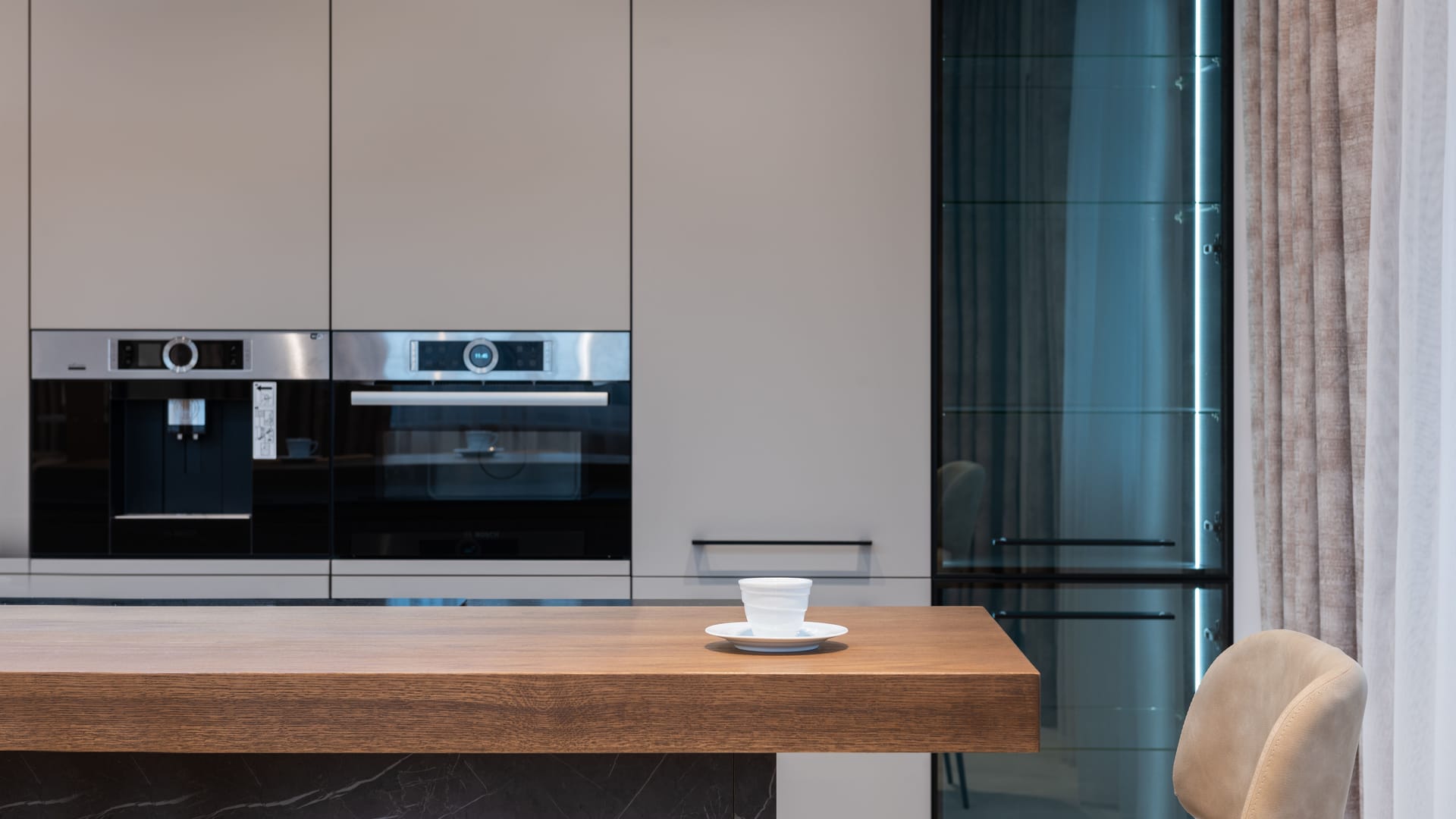
Furniture edge banding: 0.8 or 2 mm? This thickness decides whether the edge of a piece is almost sharp or clearly rounded. You look at the board from a metre away, but you touch the edge with your fingers every day. A dark glue line, a sharp corner or an edge in a different shade from the front makes furniture look cheap, even with a good decor.
Besides thickness, two things count: the material (melamine, PVC, ABS, PP, acrylic, veneer) and the way it is bonded: EVA, PUR or a zero joint made with a laser or hot air. We collected data from edge banding manufacturers and distributors (Ostermann, REHAU, Döllken/Surteco, EGGER) in tables. We added guidance for people who order boards cut to size (with a cost example) and a checklist for judging the edges of finished furniture.
Quick answer: 0.8 or 2 mm?
- 2 mm is the choice for visible edges that take knocks: tops, worktops, tables, seats. It allows a clearly rounded edge, with a radius of up to 2 mm.
- 0.8 mm is enough where the edge is not knocked and a small radius and an almost sharp edge do not bother you.
- 1 mm is described by the distributor Ostermann as particularly suitable for fronts in super-matt and high gloss.
- 0.4 mm is the thinnest finish. Ostermann lists it for shelves, reverse sides and carcasses, among others; for the visible front of a shelf we suggest 0.8–1 mm, and 0.4 mm for the back of a shelf.
- Near water or heat, thickness alone is not enough: also ask about PUR glue or a zero joint.
The rules for 0.8 and 2 mm are our conclusion from manufacturer data and from the geometry of the radius; details and sources are below. Also ours are the diagram of the edge in cross-section, the cheat sheet of place × thickness × joint, the comparison of manufacturers' conflicting figures and the 7-point checklist for accepting furniture (also for printing).
What is furniture edge banding and why does it give away cheap furniture?
Furniture edge banding (also called edge veneer or edge tape) is a strip of plastic (PVC, ABS, PP, acrylic), melamine paper or natural veneer, glued to the narrow edge of a board after it is cut. It covers the board core, completes the decor and absorbs knocks. In board shops you will find edge banding in thicknesses of 0.4, 0.8, 1 and 2 mm, among others.
A laminated board has its decor only on the two large faces, and the edges are raw after cutting. Badly chosen or poorly bonded edge banding draws more attention than the decor itself.
In finished furniture, a cheap-looking edge shows in three things:
- a visible joint, that is, the glue line between the edge banding and the board,
- rounding that is too sharp, uneven or worn through to the board,
- a colour and texture of the edge banding that do not match the surface decor.
You can check each of them with the naked eye. The checklist is further down, and the following sections explain where these differences come from.
If you are looking for furniture for a specific alcove, in the Linea shelf configurator you can set the width and height in 1 cm steps and see the price straight away.
Furniture edge banding 0.8 or 2 mm: which thickness where?
The thickness of the edge banding is matched to the edge, not to the "class" of the furniture. A 0.8 mm edge banding allows only a small radius of rounding, and a 2 mm one a clearly rounded edge; this follows from the geometry shown below. We work out the price difference of the tape in the example in the cutting section.
The German distributor Ostermann describes 2 mm as right for tables, joining edges, deep textures and furniture exposed to heavy knocks, and 0.8 mm as a thinner variant whose texture is shallower than at 1 mm. In its range it shows a typical split: 0.4 mm for reverse sides and shelves, 1 mm for carcasses and fronts, 2 mm for tables and joining edges. On the same page, however, it notes that the thin 0.4 mm is also used on the back of worktops, carcasses and side panels, among other places. This describes a product range, not a binding standard.
| Thickness | Where (according to the same page) | What it gives in furniture |
|---|---|---|
| 0.4 mm | reverse sides and shelves; also the back of worktops, carcasses, side panels | the thinnest finish, an almost sharp edge |
| 0.8 mm | described as a variant thinner than 1 mm | small radius (up to 0.8 mm), shallower texture than at 1 mm |
| 1 mm | carcass and fronts; especially super-matt, high gloss, distinctive decors | small radius, deeper texture, weaker "telegraphing" effect |
| 2 mm | tables and joining edges, furniture exposed to heavy knocks, deep textures | clear rounding, suits furniture with wide curves |
0.4 mm: the thinnest finish
In the description of the range, 0.4 mm is assigned to reverse sides and shelves, but the source also lists it for carcasses and side panels. These are usually edges that nobody touches or hits. The edge is almost sharp, because the radius of rounding cannot exceed 0.4 mm. That is why we suggest 0.8–1 mm for the visible front of a shelf and keep 0.4 mm for the back of a shelf, as in the table for cut parts below.
0.8 and 1 mm: fronts and carcasses with a calm surface
The difference between 0.8 and 1 mm is only 0.2 mm, but with 1 mm edge banding a deeper texture can be made, which gives a more realistic look and feel. A 1 mm edge banding also shows less of the wood fibres coming through from the board core (the so-called telegraphing effect). The distributor describes it as particularly suitable for super-matt, high gloss and distinctive decors. If the edge banding on a rough board core is to have a perfect gloss or matt finish, it recommends at least 1 mm.
2 mm: worktops, tables and places that take knocks
A 2 mm edge banding is described as right for tables, joining edges, surfaces with a deep texture and furniture exposed to heavy knocks. In practice this is the front edge of a desk top, the edge of a table or the seat of a bench: places where a chair, a bag or a shoe catches. If you are choosing a made-to-measure desk, this is the edge to ask about.
Radius of rounding: why 0.8 mm will not give a soft edge
In the edge banding machine, glue, most often EVA or PUR, goes onto the board edge, and rollers press the edge banding on. Then units trim the excess edge banding at the ends and mill it along the edge. A profile scraper smooths the milled radius, and a flat scraper removes the excess glue.
The radius cannot be larger than the thickness of the edge banding, because the cutter would then go into the board surface and cut away the decor. This is simple geometry: a 0.8 mm edge banding allows a barely softened edge, and a 2 mm one a clearly rounded edge that is pleasant in the hand. This agrees with the distributor's description, which links 1 mm with a "small radius" and 2 mm with furniture with wide curves.
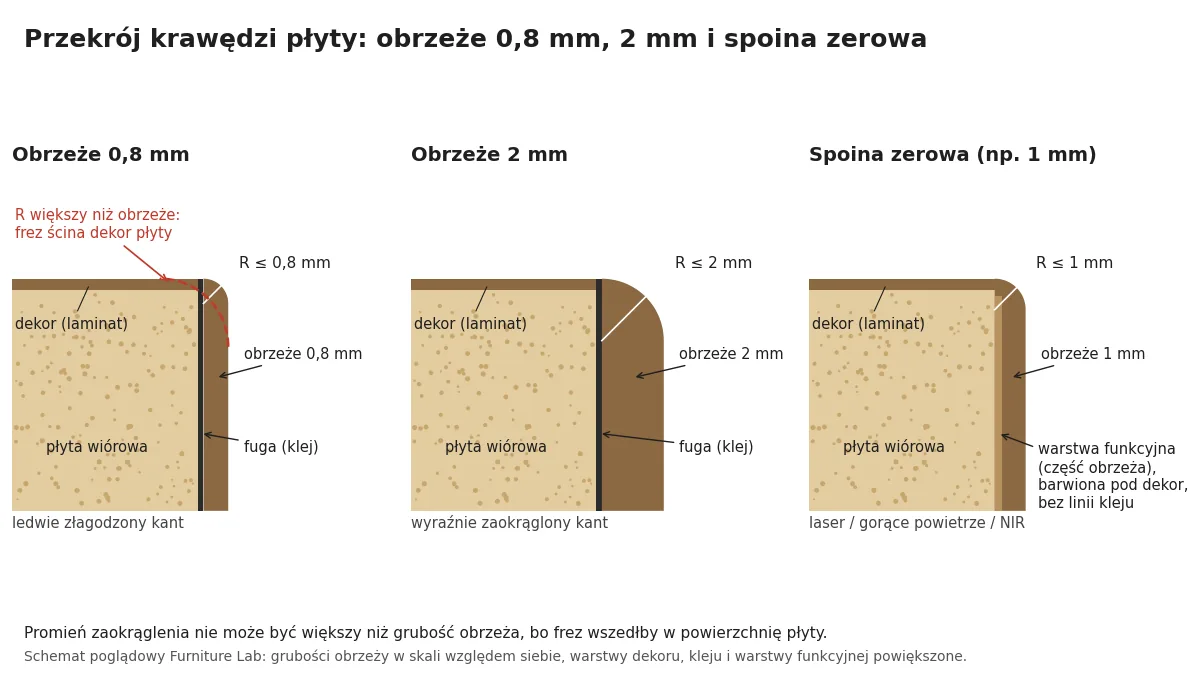
Diagram: a 0.8 mm edge banding allows a radius of up to 0.8 mm, a 2 mm one R2. With a zero joint there is a functional layer instead of a glue line; it is part of the edge banding and is sometimes coloured to match the decor. The thicknesses of the glue, decor and functional layers are enlarged.
Ordering a board cut to size with edge banding? What to state and which thickness to choose
When you order cut parts, you decide which edges to band and with which edge banding. WoodConnect, a dealer of EGGER boards with a cutting and edge banding service, advises stating for each part the dimensions (length × width in mm), the number of pieces, the edges to band and the direction of the grain. The length is given along the grain, because with wood-effect decors turning a part by 90° puts the grain across.
You choose the thickness and width of the edge banding from the service's offer. In the shop Płyta Meblowa (Meble.pl S.A.), the thickness filter for EGGER and REHAU edge banding includes 0.4, 0.8, 1 and 2 mm, among others, and 0.8 mm edge banding comes in widths of 23, 28, 33 and 43 mm (as of 16.09.2026). The width of the edge banding must cover the full thickness of the board, and the cutter of the edge banding machine removes the excess.
Which thickness for which parts? Below is our suggestion. It is a conclusion from the distributor's description of thicknesses and from the geometry of the radius, not a manufacturer's recommendation:
| Edge of the part | Edge banding | Why |
|---|---|---|
| front of a worktop, top, seat | 2 mm | clear radius, an edge exposed to knocks |
| edges of fronts | 1 mm (2 mm if the edge is to be clearly rounded) | 1 mm described as particularly suitable for super-matt and gloss |
| visible edges of the carcass, front of shelves | 0.8–1 mm | thin finish with a small radius |
| back of shelves, edges facing the wall | 0.4 mm | the thinnest thickness in the described split |
An example of one order line: "shelf 764 × 300 mm, 4 pcs, band one longer edge with 1 mm edge banding, grain along 764 mm". Also ask whether the stated dimension includes the edge banding. With 2 mm edge banding on two opposite edges the difference is 2 × 2 = 4 mm, which matters when planning the gaps between fronts.
If you apply the edge banding yourself, without an edge banding machine, look for edge banding with hot-melt glue already applied at the factory. For example, real wood edge banding from Ostermann can be ordered with such glue on request. How to stick on this kind of edge banding with an iron, we show in the guide to repairing peeling edge banding.
How much does the difference between 0.8 and 2 mm cost?
The cost of edge banding depends on its material, thickness, width and decor. Compare current rates per running metre for the same width and the same decor. Check whether the price covers the tape alone or also the edge banding service.
You can work out the difference with a formula: running metres of banded edges × (price of 2 mm − price of 0.8 mm). Example: a top measuring 160 × 45 cm banded on four edges is 2 × 1.60 + 2 × 0.45 = 4.10 m. Multiply 4.10 m by the difference between the current rates for the two edge banding variants.
ABS or PVC edge banding, or perhaps PP, melamine or acrylic?
Edge banding for laminated boards is made of resin-impregnated paper (melamine) or of thermoplastics: PVC, ABS, PP and acrylic (PMMA). The plastics differ in heat resistance. According to REHAU technical data, the Vicat softening temperature (ISO 306) is 72 °C for PVC, 85 °C for ABS and 100 °C for PP.
| Material | What it is | Softening temp. (Vicat) | Strengths according to manufacturers | What to watch for |
|---|---|---|---|---|
| Melamine | printed paper impregnated with resin, lacquered (Surteco) | no data in the sources | Surteco: durable, chemically resistant lacquer, can be used on profiled edges | Surteco does not state its impact resistance, so it cannot be fairly compared with the plastics |
| PVC | polyvinyl chloride | 72 °C (REHAU) | REHAU: valued for decades for its price-to-properties ratio, self-extinguishing, recyclable | the lowest of the values given exactly in the REHAU sheet; contains chlorine |
| ABS | acrylonitrile butadiene styrene | 85 °C (REHAU), 94 °C (Döllken) | impact resistant, chlorine-free (Döllken); recyclable or can be incinerated (REHAU) | the Vicat value depends on the manufacturer: 85 °C at REHAU, 94 °C at Döllken |
| PP | polypropylene | 100 °C (REHAU) | REHAU: little energy needed to produce, recycling or incineration, only CO₂ and water when burned | the REHAU sheet lists no drawbacks; this is manufacturer data, not an independent test |
| Acrylic (PMMA) | transparent plastic with a print on the underside | > 80 °C (REHAU summary sheet); about 80 °C in a separate PMMA sheet | REHAU: 3D depth effect, UV lacquer protects against scratches | the two sheets give the value differently, so it is not possible to say honestly whether it softens earlier than ABS |
Vicat values differ between manufacturers: ABS edge banding has 85 °C in the REHAU sheet and 94 °C in the Döllken technical information. So compare data from a single technical sheet, not figures from different shops.
Melamine edge banding: paper instead of plastic
Melamine edge banding is paper with a printed decor, impregnated with thermosetting resin and covered with lacquer. Surteco describes it as durable, with a chemical-resistant lacquer, and also suitable for profiled edges. In this description, however, the manufacturer gives neither the thickness nor the impact resistance, so we leave those fields empty in the table.
PP and 3D acrylic edge banding
Polypropylene has the highest of the three values given exactly in the REHAU sheet (100 °C against 85 °C for ABS and 72 °C for PVC). Acrylic, that is PMMA, is chosen for its effect. REHAU writes that the transparent material gives a three-dimensional effect, and the pattern is printed on the underside, so it stays visible even after the radius is milled. The manufacturer shows such edge banding as an accent on furniture fronts.
Environment: ABS and PP versus PVC
ABS and PP contain no chlorine. Döllken writes that offcuts of ABS edge banding can be burned without problems together with chipboard waste in plants that have the right permits. REHAU states that PP gives only carbon dioxide and water when burned. That does not make PVC a "bad" material: REHAU stresses that it is self-extinguishing and recyclable. But if you want furniture without chlorine in its plastics, ask for ABS or PP.
Edge banding for veneer: wood on the edge
A veneered board takes edge banding made of natural veneer. In the catalogue of real wood edge banding, most items are 2 mm, 1 mm and 0.5 mm thick; there are sanded versions and ones reinforced with fleece. An article on mebleinfo.pl (no publication date visible) describes this company's oak edge banding as ready to be finished with oil, stain or lacquer right after fitting.
This way the edge gets the same oil as the surface of the board. A plastic edge banding with a printed wood pattern will not absorb oil, so its colour and gloss will not change together with the oiled surface. We will cover the differences between laminated and veneered boards in a separate article; you will find our other texts about boards in the category Materials and boards.
EVA glue, PUR or laser edge banding (zero joint)?
The durability of an edge is decided by the joint, that is, the place where the edge banding meets the board. According to the Ostermann guide to glues, EVA glue is still the most popular but can let go at high temperature. PUR glue cures chemically and withstands water better. A zero joint uses no glue at all.
| Joint | How it works | Is the joint visible | Moisture and heat |
|---|---|---|---|
| EVA hot-melt glue | glue applied hot, holds the edge banding once cooled; it can be heated again | a glue line is there; EGGER lists joint-free edge banding as particularly suitable for light decors | the joint can come off under high temperature |
| PUR hot-melt glue | polyurethane, cures chemically and does not soften again with heat | a glue line is there | recommended when the connection must be especially resistant to water or high temperature |
| Zero joint (laser, hot air, infrared) | energy melts the functional layer on the underside of the edge banding, no separate glue | optically no; REHAU and EGGER colour the layer to match the decor | more resistant to moisture, heat and dirt than an EVA joint |
EVA glue: the standard that does not like heat
EVA glue (ethylene vinyl acetate) melts in the machine and hardens as it cools. It can be reactivated by heat, which is why the joint can come off in unfavourable conditions. The guide gives an example: next to a kitchen oven.
PUR glue: when the edge is in contact with water
PUR (polyurethane) reacts chemically after application and does not return to a liquid state under heat. The same guide recommends it for connections that must be especially resistant to water or high temperature. That is why, for bathroom and kitchen cabinets, ask for PUR.
Laser edge banding, or zero joint
Laser edge banding has a functional layer of plastic on its underside. The machine melts it with a laser, hot air or infrared radiation and bonds it to the board without glue. In RAUKANTEX pro edge banding REHAU uses a functional layer that is 100% glue-free and offers an OMR layer resistant to steam, for example near dishwashers, cooker hoods and in damp rooms. EGGER makes ABS Seamless edge banding for HotAir and laser technology, with a coloured functional layer matched to the decor, structure and gloss of its boards.
The names of the technologies depend on the machine maker: at HOMAG it is, for example, airTec, at Biesse AirForce System; both work with hot air. REHAU writes that the colour of the functional layer is matched to the decor, which gives the impression of solid material and means dirt in the joint is no longer a problem. Ostermann, which makes the functional layer from thermoplastic polyurethane (TPU), writes that such a connection is more resistant to moisture, heat and dirt than a joint with EVA glue.
A zero joint needs edge banding matched to the technology (laser, hot air, NIR) and a suitable machine, so not every furniture maker uses it. You also cannot tell the type of glue with certainty from the look of the edge alone, so it is best to ask the seller directly about the joint.
Which edge banding for the bathroom and kitchen?
Near water and steam, the thickness of the edge banding is not enough; the resistance of the joint counts too. Look for PUR glue or a zero joint in a moisture-resistant variant. If you are planning furniture for a bathroom, ask about these two things through the contact form.
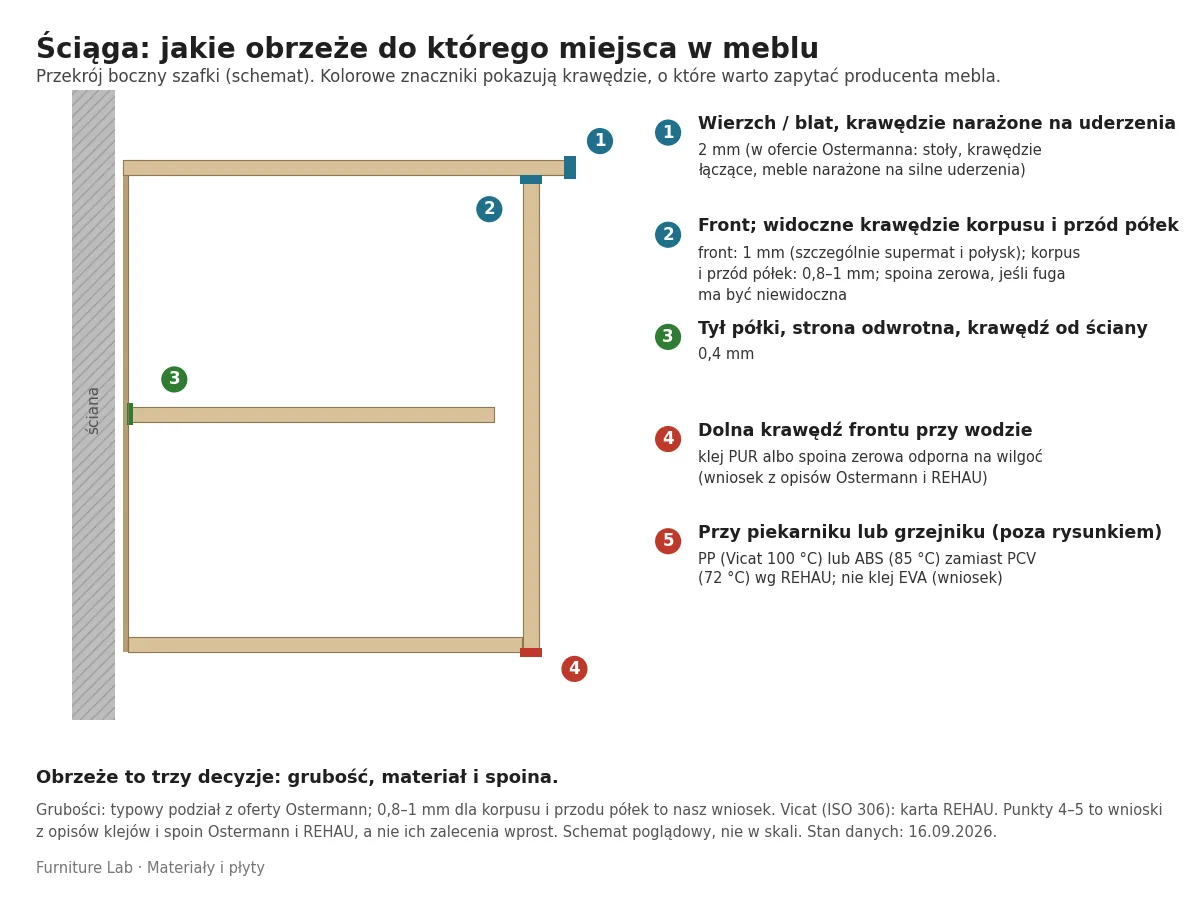
Cheat sheet: which edge banding for which place in the furniture?
In practice, edge banding comes down to three decisions: thickness, material and joint. The table below collects the data from the previous sections in one place. The thicknesses are the typical split from the distributor's range described above, supplemented by our suggestion of 0.8–1 mm for visible carcass edges and the front of shelves. The softening temperatures come from the REHAU sheet. The column "Joint and finish" and the rows about water and heat are our conclusions from the descriptions of glues and joints, not direct manufacturer recommendations.
| Place in the furniture | Thickness | Material | Joint and finish |
|---|---|---|---|
| back of shelves, reverse sides, edges facing the wall | 0.4 mm | ABS in the decor colour | standard, e.g. EVA, if the edge does not come into contact with water or heat |
| visible edges of the carcass, front of shelves | 0.8–1 mm | ABS, PVC or PP | standard or zero joint if the joint is to be invisible |
| fronts, especially super-matt and gloss | 1 mm | ABS, PVC or PP; acrylic for a 3D effect | zero joint if the joint is to be invisible |
| top, worktop, joining edges and edges exposed to knocks | 2 mm | ABS, PVC or PP | PUR or zero joint if the worktop is sometimes wiped wet |
| bathroom cabinet, cabinet by a sink | as above, depending on the part | thermoplastic | PUR or zero joint in a moisture-resistant variant |
| edge near an oven or radiator | as above, depending on the part | PP (100 °C) or ABS (85 °C) instead of PVC (72 °C) | PUR or zero joint, not EVA |
| veneered board | most items in the catalogue: 0.5, 1 and 2 mm | natural veneer of the same species as the board | edge finished with the same oil as the surface |
The table is no substitute for a conversation with the furniture maker, because the final choice also depends on the decor and the machines they have. It does show what to ask about for a specific piece.
How to judge the quality of an edge in finished furniture: a checklist
You can check the quality of edge banding without tools. Daylight, a fingernail and the seven points below are enough. The checklist works the same way in a furniture shop as when you accept made-to-measure furniture.
- Joint. Look at the line where the edge banding meets the board, at an angle, against the light. A thin dark or light line is glue. With a zero joint, manufacturers such as REHAU and EGGER colour the functional layer to match the decor, so the line is usually not visible.
- Rounding. Run a finger along the edge. The edge should be even along its whole length, with no waves and no places where the light core of the board shows through under the edge banding.
- Colour and structure. The edge banding should have the same shade, texture and degree of gloss as the surface. EGGER matches edge banding to the decor, structure and gloss of its boards; how to read decor codes, we explain in the text on board decor designations, e.g. H1180 ST37.
- Corners. At the corners the edge banding must not stick out or have sharp burrs. A protruding corner is easily caught by a cloth, and water gets under a lifted edge banding.
- Telegraphing effect. On a super-matt or gloss front, look at the edge banding against the light from the side. Small unevenness of the board underneath should not show on it.
- Less visible edges. Look at the back edges of shelves and sides. Even there thin edge banding is used, for example 0.4 mm; if an edge is not banded, ask the maker whether this is deliberate.
- Places near water and heat. In a bathroom cabinet, check the lower edges of the doors and sides. They are easily splashed, so the joint must have no gaps.
The same points are on the printable checklist (PDF, A4), which you can take to a furniture shop or keep with you when accepting furniture.
If the edge banding is already coming off or an edge has swollen from water, see the guide on how to repair a swollen edge and a chip. To keep the edge from taking in water while you clean, also check how to wash a board next to the edge banding.
Three questions for the seller before ordering
- What is the edge banding made of: melamine, PVC, ABS or PP?
- What is the thickness of the edge banding on the fronts, and what on the carcass, shelves and edges facing the wall?
- What is the joint: EVA glue, PUR or a zero joint?
Edge banding in Furniture Lab furniture: what to ask before ordering
We make our made-to-measure furniture from two materials: laminated board (decors Natural Halifax Oak, Matt White, Cashmere Grey, Dark Concrete, Lincoln Walnut) and veneer (Oiled Oak, Bleached Ash, Oiled American Walnut). You set the dimension in 1 cm steps, and production takes up to 10 working days.
If the edge matters to you, for example in a bathroom cabinet or a table top, ask us the three questions from the list above before ordering: about the material, thickness and joint of the edge banding in the piece you chose. The simplest way is through the contact form. The furniture comes with a 24-month guarantee.
FAQ: the most common questions about furniture edge banding
Is 0.8 mm edge banding enough for fronts?
Not always. For fronts in super-matt and high gloss, the distributor Ostermann describes 1 mm edge banding as particularly suitable: it can have a deeper texture than 0.8 mm and shows the core fibres less. A 0.8 mm edge banding also gives a smaller radius, so the edge of the front will be almost sharp.
ABS or PVC edge banding: which is better?
It depends on what matters more. In the REHAU sheet, ABS softens later than PVC (85 °C against 72 °C), and Döllken stresses that ABS contains no chlorine. REHAU describes PVC as self-extinguishing, recyclable and valued for its price-to-properties ratio. Near a heat source, ABS has the advantage.
What is laser edge banding (zero joint)?
Laser edge banding has a functional layer on its underside, which a laser, hot air or infrared melts and bonds to the board without glue. The joint is optically invisible. According to Ostermann, such a connection is more resistant to moisture, heat and dirt than a joint with EVA glue.
How do you recognise laser edge banding in finished furniture?
Look at where the edge banding meets the board, against the light. With a zero joint you usually cannot see a glue line, because REHAU and EGGER colour the functional layer to match the decor. The look alone does not give certainty about the type of joint, so ask the seller.
Why does edge banding come off the board?
Edge banding comes off when the joint lets go. A joint with EVA glue can come off at high temperature, for example near a kitchen oven. Water under a lifted corner makes the board swell. Small areas of peeling can be repaired, as we describe in the guide to repairing an edge.
Is 2 mm edge banding always better?
No. A 2 mm edge banding makes the most sense where the furniture takes knocks or has rounded edges: in worktops, tables, benches. On super-matt or gloss fronts, 1 mm works well, and machining it produces only a small radius.
Summary: match the edge banding to the place in the furniture
For furniture edge banding, 0.8 or 2 mm, choose by edge: 2 mm for edges exposed to knocks and where the edge is to be clearly rounded, 0.8–1 mm for visible carcass edges and the front of shelves, and 1 mm especially for fronts in super-matt and gloss. The material decides heat resistance, and the joint decides how the edge copes with water. When you accept the furniture, go through the checklist: joint, rounding, colour, corners.
Design furniture made to measure to the centimetre, and you will see the price straight away in the configurator. Courier shipping across Poland is free, and the guarantee covers 24 months.
How we prepared this text. The data on thicknesses, materials, glues and joints comes from the technical sheets and websites of edge banding manufacturers and distributors, and the description of the edge banding machine and of ordering cut parts from the websites of companies in the industry (list below). We checked all sources on 15–16.09.2026. We did not test edge banding for the purpose of this article. The explanation of the radius of rounding is simple geometry, and the table of edge banding by part and the rows of the cheat sheet about water and heat are our conclusions; we say so in the text. The diagrams and the printable checklist were prepared by the editorial team on the basis of this data. If you find a mistake, write to us through the contact form.
Sources
We checked the data on 15 and 16 September 2026 in the materials of manufacturers, distributors and companies in the industry:
- Ostermann, A suitable edge banding for every project – thicknesses of 0.4, 1 and 2 mm and their uses.
- Ostermann, Basic knowledge – glues – hot-melt glues EVA and PUR.
- Ostermann, Edge banding for zero joints – laser, Airtec, Infratec.
- Ostermann, Real wood edgings – catalogue of real wood edge banding (as of 16.09.2026).
- REHAU, Edgeband Technical Data – PVC, ABS, PP, PMMA, Vicat softening temperatures (ISO 306).
- REHAU, RAUKANTEX PMMA Technical information – acrylic edge banding.
- REHAU, RAUKANTEX pro – edge banding for a zero joint.
- Döllken (Surteco), ABS Edgebands Processing Information – properties of ABS.
- Surteco, Paper-based melamine edges – melamine edge banding.
- EGGER, ABS Seamless edge banding – edge banding for HotAir and laser technology.
- HOMAG, airTec case study – hot air technology.
- Furniture Production, Biesse AirForce System – interview about hot air technology.
- CEHPOL, Automation in the edge banding of furniture boards (07.08.2026) – stages of edge banding machine work.
- WoodConnect, Furniture board cut to size: how to order cut parts (01.05.2026) – data for ordering cut parts.
- Płyta Meblowa (Meble.pl S.A.), 0.8 mm edge banding and 2 mm edge banding – available thicknesses, widths and prices (as of 16.09.2026).
- Mebleinfo.pl, Oak veneer edge banding from Ostermann (undated article) – finishing of veneer edge banding.
Published: 15.09.2026 · Updated: 16 September 2026.
Furniture for your wall, to the centimetre
See what you can design to measure, or go to the recommended page.
Read next
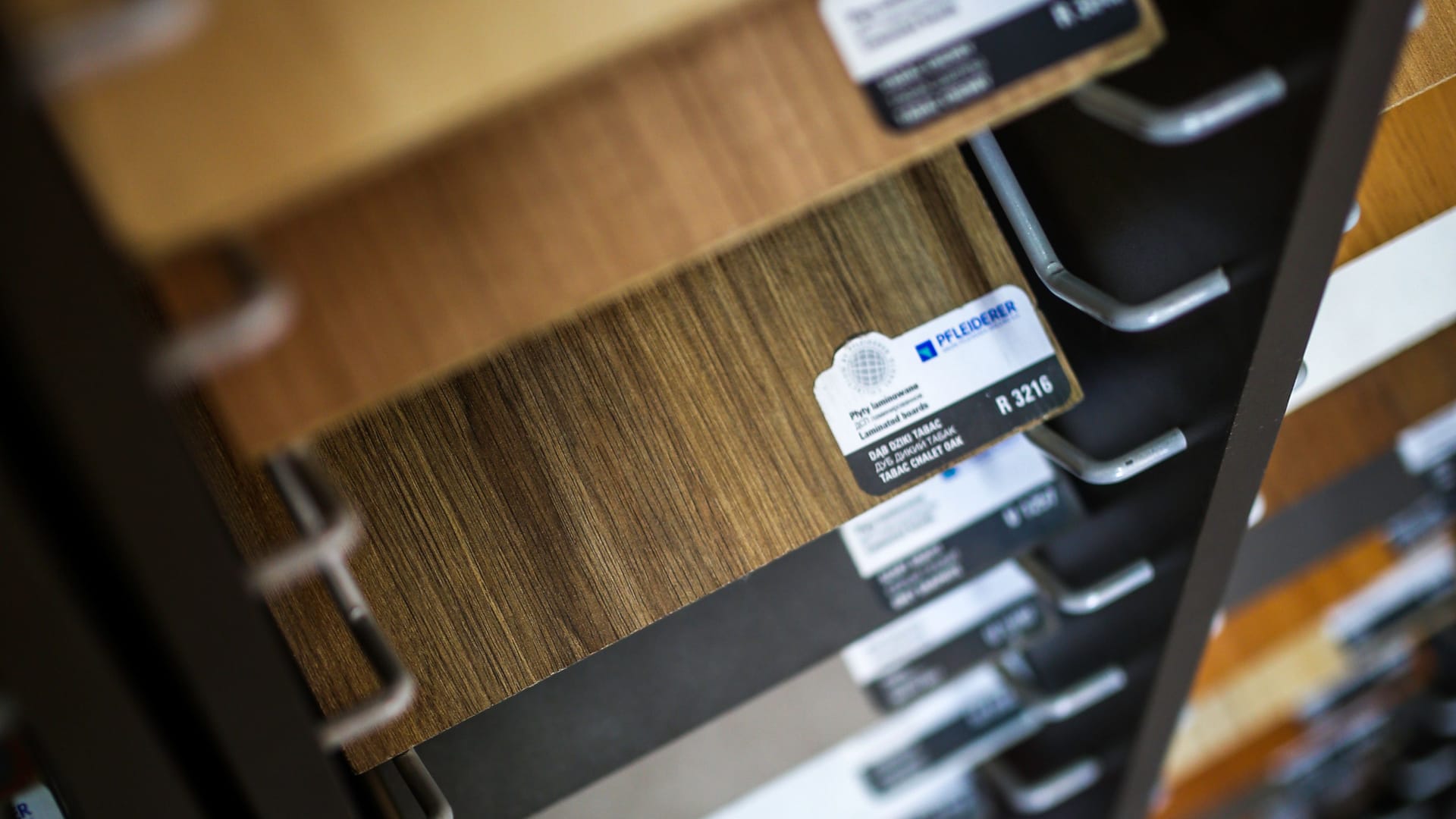 Materials and boards
Furniture board decor codes: how to read them
What do H1180 ST37 and K003 PW mean? A furniture board decor code split into parts, the Sonoma oak trap and an order checklist. See the decoder table.
18 min read
 Furniture care
How to clean laminate and veneer furniture
How to clean laminate and veneer furniture? A YES/NO table for 12 household products, based on EGGER, Kronospan and oil makers. Check before you wash a front.
23 min read
 Advice
How to choose furniture colour: sample test
How to choose furniture colour when a screen and a bulb alter a decor's shade? Test a sample at home in 9 steps: light, floor, upright and flat. PDF checklist.
27 min read