Furniture board decor codes: how to read them
What do H1180 ST37 and K003 PW mean? A furniture board decor code split into parts, the Sonoma oak trap and an order checklist. See the decoder table.
Autor: Amussim editorial team
Opublikowano:
Ostatnia aktualizacja:
18 min read
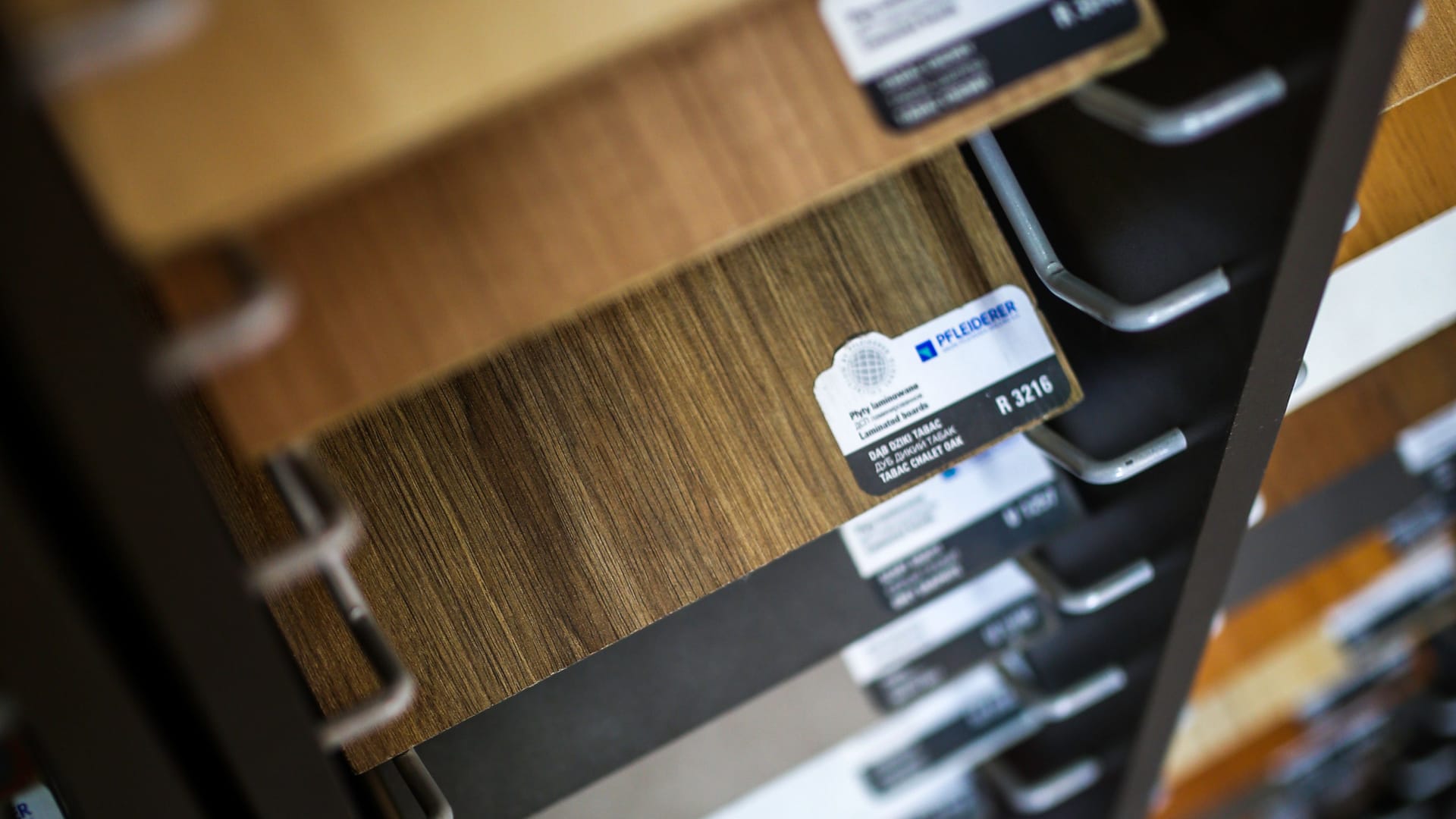
A furniture board decor code tells you who made the board, which pattern is printed on it and what texture the surface has. One page shows "H1180 ST37", another says "Halifax Oak", and in the Kronospan catalogue a worktop in decor K003 has a different texture abbreviation than the board. A trade name alone does not give you that certainty. Shops sell boards from several manufacturers under the name "Sonoma oak", each with a different number, and Pfleiderer has more than one Sonoma decor in its catalogue.
Below we break down the codes used by EGGER, Kronospan, Pfleiderer and Swiss Krono. We checked every example on the manufacturer's website or on a shop product page; the addresses are in the text or in the "Sources" section at the end. We prepared three materials of our own for this: a decoder table for the four manufacturers, a summary of where the sources disagree with conclusions for ordering, and a printable order card.
What does a furniture board decor code consist of?
A furniture board decor code (also called a decor symbol) is a designation assigned by the board manufacturer that points to one specific surface. It consists of a decor number, which describes the printed pattern and colour, and a texture code, which describes the feel of the surface. In H1180 ST37 the decor number is H1180 and ST37 is the Feelwood Rift texture.
EGGER calls this decor Natural Halifax Oak (decor page H1180 ST37).
For a reliable identification you also need the manufacturer. Numbers from different companies can look alike: Kronospan has decor 3025 and Swiss Krono has D3025. The least dependable part is the trade name, because it can differ between markets and even between the manufacturer's site and a shop.
The table breaks six real designations into parts:
| Designation | Manufacturer | Decor number | Texture | Name in the source |
|---|---|---|---|---|
| H1180 ST37 | EGGER | H1180 | ST37 Feelwood Rift | Natural Halifax Oak (Dąb Halifax naturalny) |
| W1000 ST9 | EGGER | W1000 | ST9 Smoothtouch Matt | Premium White (Biały premium) |
| K003 PW | Kronospan | K003 | PW Pure Wood | Gold Craft Oak; in Polish shops Dąb Craft złoty |
| 3025 SN | Kronospan | 3025 | SN Super Natural | Light Vintage Oak; in Polish shops Dąb Sonoma jasny |
| R20128 LN | Pfleiderer | R20128 | LN | Sonoma Oak (Dąb Sonoma) |
| D3025 OW | Swiss Krono | D3025 | OW | Sonoma Oak (Dąb Sonoma) |
The number and the texture identify the surface; the name only describes it. Apply this rule to every purchase.
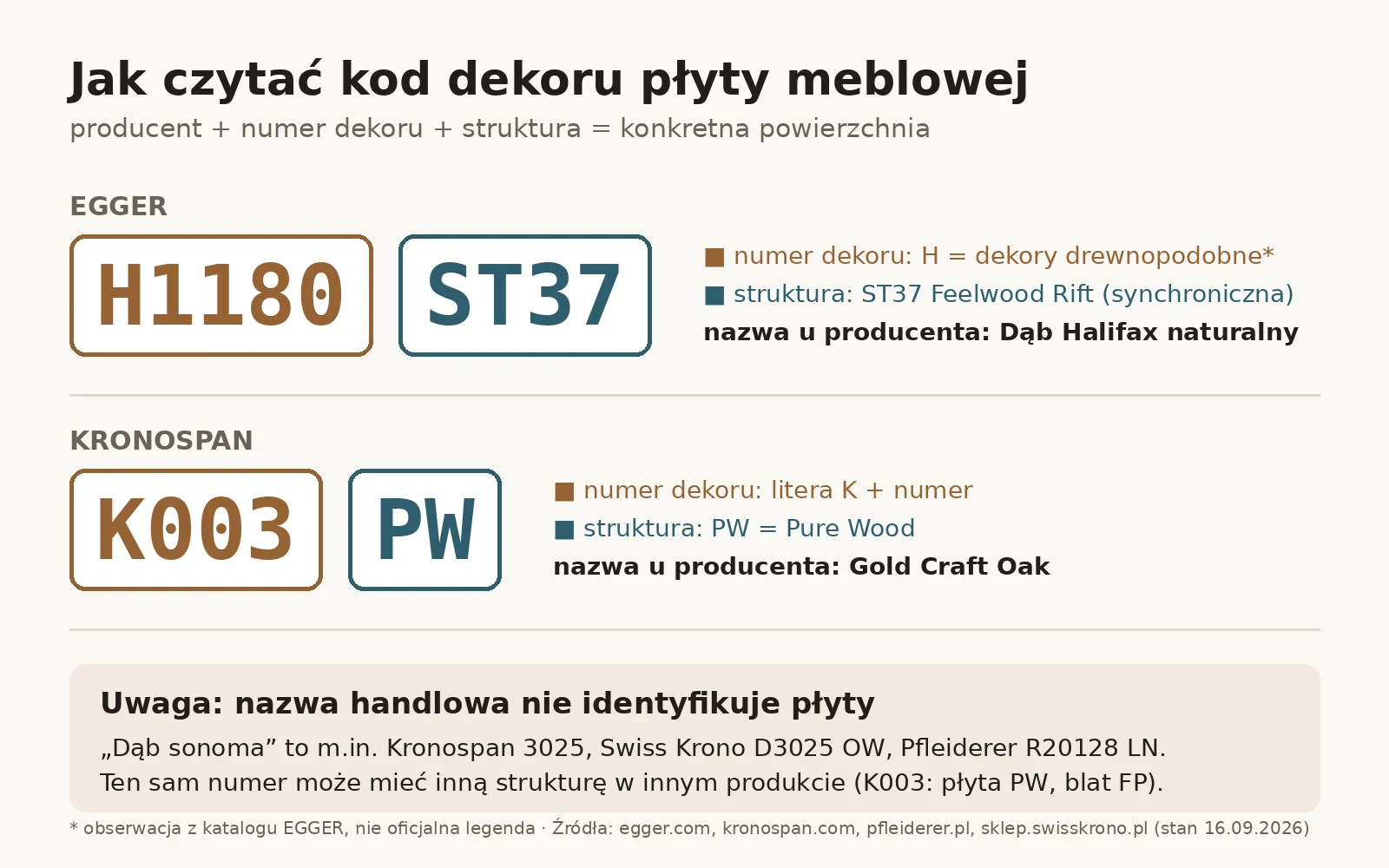
How to read a decor code step by step
- Find the full designation. Look for it on the product page, on the sample or on the manufacturer's decor page. The EGGER page address contains both elements, for example
dekory/H1180_37. - Identify the manufacturer. Without it a number can be ambiguous: Kronospan 3025 and Swiss Krono D3025 are decors from two different companies.
- Separate the decor number from the texture. In EGGER the number starts with a letter (H1180) and the board texture is ST followed by a number, or the abbreviation PM or PG; edgings can have separate codes, for example RO. In Kronospan the number is digits or K with digits (K003) and the texture is two letters (PW).
- Check the first letter of the number (EGGER). In the catalogue, wood-look decors start with H, stone imitations with F, plain colours with U and whites with W. This is an observation, not an official legend from the manufacturer.
- Look up the texture name in the manufacturer's glossary, because the same letters mean different things at different companies.
- Compare the trade name with the manufacturer's catalogue. If a shop gives a different name, go by the number.
- For edging, worktops and HPL laminate, check the texture separately for each product.
Where to find the decor code
The full designation is easiest to find where the manufacturer or seller describes the board: on the decor page, on the shop product page and on the sample. Product names in shops are sometimes marked with the code, for example "D3025 OW DĄB SONOMA – laminated board sample" in the Swiss Krono shop. If you are buying finished furniture, ask the seller for the board manufacturer and the full decor designation, because the colour name in the furniture description is not enough.
If you need to replace a part years later, also check whether the decor is still on offer. EGGER issues numbered collections: the Decorative Collection 26+ has 10 new decorative board decors alongside the decors from the 24+ collection. For the 2020–23 collections the manufacturer published a separate list of decors with changed availability.
Treat the colour on a decor page as a guide and compare it with a sample or swatch in the end. For some decors EGGER gives NCS and RAL references, for example NCS S0502-G and RAL 9003 for W1000 ST9 Premium White. It adds, however, that this is the "closest available, not necessarily perfect match", and for H1180 ST37 it recommends "comparison with an actual sample".
If you are choosing finished furniture rather than the board itself, start with the dimensions. In the Linea Shelf configurator you set the width and height in 1 cm steps and see the price straight away. We offer laminated board in five decors, which we describe next to the order checklist.
EGGER designations: the letters H, F, U, W in the decor number and the ST texture
EGGER designations follow a repeating pattern: wood-look decors have numbers starting with H, stone imitations with F, plain colours with U and whites with W. This is our observation from the decor pages, not a legend published by the manufacturer. The number is followed by the texture code, most often ST with a number, for example ST9 Smoothtouch Matt.
Examples from the EGGER catalogue: H1180 ST37 Natural Halifax Oak and H1145 ST10 Natural Bardolino Oak (wood), F244 ST76 Anthracite Candela Marble and F235 ST76 Scivaro Slate (stone), U960 ST9 Grey Onyx (plain colour) and W1000 ST9 Premium White (white). Whether the letter F also covers other materials is something you check on the page of the specific decor.
The most common EGGER textures and what they mean
EGGER does not publish a legend for the numbers after ST. The pages do show, though, that the number does not grow with the depth of embossing: ST9 is a smooth matt, ST10 a rough wood texture and ST76 a stone texture. The descriptions below summarise the EGGER textures page and its English version.
| Code | Name at EGGER | How the manufacturer describes it |
|---|---|---|
| ST9 | Smoothtouch Matt | neutral, velvety matt on plain colours, wood and other materials |
| ST10 | Deepskin Rough | rough-to-the-touch texture for natural wood decors, with a continuous matt look |
| ST12 | Omnipore Matt | pores of varying depth spread over the whole surface |
| ST17 | Omnipore Oiled | the newest version of irregular wood pores across the whole surface, with very low gloss |
| ST19 | Deepskin Excellent | combines cathedral-grain cuts with linear sections |
| ST22 | Deepskin Linear | deep, linear character with a matt-gloss effect |
| ST37 | Feelwood Rift | texture synchronised with the Halifax Oak decor series; cracks in the pattern are particularly visible |
| ST76 | Mineral Rough Matt | mottled, slightly rough stone surface |
| PM | PerfectSense Premium Matt | lacquered, velvety surface for plain colours |
| PG | PerfectSense Premium Gloss | lacquered high-gloss surface |
Not every EGGER surface starts with ST. The lacquered PerfectSense surfaces use the abbreviations PM (matt) and PG (gloss), so "U665 PM" is also a complete designation.
Feelwood, or synchronised textures
A synchronised texture is an embossing that follows the printed wood pattern, so you can feel pores and cracks with your finger exactly where you see them. EGGER calls this group Feelwood and states that ST37 Feelwood Rift is synchronised with the Halifax Oak decor series.
That is why you will meet ST37 on several decors in this series: H1176 ST37 White Halifax Oak, H1180 ST37 Natural Halifax Oak, H1181 ST37 Tobacco Halifax Oak and H3176 ST37 Pewter Halifax Oak. "Halifax Oak" without an adjective is therefore at least four different decors. In an order, the number counts, not the word "Halifax".
Kronospan textures PW, SN, SU, PE, BS: how to read them
Kronospan designates a decor with a number (for example 3025) or a number with the letter K (for example K003), followed by a two-letter texture abbreviation. According to the Kronospan texture glossary, PW is Pure Wood, SN is Super Natural, SU is Super Matt, PE is Pearl and BS is Bureau Structure.
| Abbreviation | Full name | Manufacturer's description (abridged) | Kronospan group |
|---|---|---|---|
| PW | Pure Wood | texture inspired by lacquered veneer | porous |
| FP | Fine Pore | delicate wood grain | porous |
| SN | Super Natural | linear, grainy, with a matt-gloss effect | deep |
| SU | Super Matt | matt with a smooth, high-quality look | matt |
| SM | Silk Matt | semi-matt with a smooth, silky finish | matt |
| PE | Pearl | grainy surface with a sand effect | grainy |
| BS | Bureau Structure | pleasant, mottled surface | grainy |
| HG | High Gloss | high gloss | gloss |
At Kronospan the letters abbreviate English names, while at EGGER ST comes before the number. The same two letters can mean something entirely different at different companies. RT is Rust at Kronospan, a texture imitating aged concrete and metal, and Rustic Wood at Pfleiderer.
The same decor number, a different texture depending on the product
One decor number can have different textures in different products. On the decor page for K003 Gold Craft Oak Kronospan assigns the PW texture to laminated particleboard, laminated MDF, HPL Standard laminate and door laminates. Worktops with a rounded edge, HPL worktops and HPL edgings for worktops have the FP texture. Furniture edging has the PW texture on the English version of the page.
In practice, a K003 work surface matched to K003 PW fronts will show the same wood pattern but a different feel. If that does not bother you, fine. If it does, check the texture before you order, not after delivery. In Polish shops this decor is sold as Dąb Craft złoty K003.
Sonoma oak from different manufacturers: why it is not the same decor
"Sonoma oak" is a trade name, not a decor number, so at different manufacturers it means different products. In Poland, Kronospan 3025 and Swiss Krono D3025 OW are sold under this name, and Pfleiderer has at least three decors with Sonoma in the name: R20128, R20006 and R20031.
| Manufacturer | Designation | Name in the source | Texture |
|---|---|---|---|
| Kronospan | 3025 | Light Vintage Oak (kronospan.com); Dąb Sonoma jasny (Polish shops) | SN, PE |
| Swiss Krono | D3025 | Dąb Sonoma (sklep.swisskrono.pl) | OW |
| Pfleiderer | R20128 | Dąb Sonoma | LN |
| Pfleiderer | R20006 | Sonoma Oak | RT Rustic Wood (HPL laminate) |
| Pfleiderer | R20031 | Truffle Sonoma Oak | DU, RT |
| EGGER | H1145 | Natural Bardolino Oak (Dąb Bardolino naturalny) | ST10 Deepskin Rough |
The name drifts even for a single number: decor 3025 appears on kronospan.com as Light Vintage Oak and in Polish shops as "light Sonoma oak". One manufacturer can also have several "Sonomas" with different numbers and textures, as Pfleiderer does. And a similar number (3025 and D3025) does not mean the same board, because these decors come from two different companies.
Where the sources disagree and what follows from it
EGGER does not call decor H1145 ST10 Sonoma but Natural Bardolino Oak. Accessory shops nevertheless link the two names: meble.pl sells an edge cap described as "Sonoma oak / Egger H1145" and lists a match to four boards: "Egger H1145, Pfleiderer R20128, Kronpol D3025, Kronospan 3025" (spelling as in the source). The distributor Ostermann, for the board Kronospan 3025 SN, suggests, among others, edgings from the "Natural Bardolino Oak" series with number 1145. It stresses, however, that the list is only meant to help you find an edging, and recommends free samples to check the colour.
We put these discrepancies into one table. The last column is our conclusion, not the position of the manufacturers.
| Source A | Source B | Conclusion for ordering |
|---|---|---|
| kronospan.com: decor 3025 is Light Vintage Oak | Polish shops: 3025 SN is light Sonoma oak | Search by the number 3025, not by the name. |
| EGGER: H1145 ST10 is Natural Bardolino Oak | meble.pl: one "Sonoma oak" edge cap for Egger H1145, Pfleiderer R20128, Kronpol D3025 and Kronospan 3025 | An accessory assigned to four decors is an approximation. Compare the shade with the board. |
| Ostermann: among others, Bardolino 1145 edging for Kronospan 3025 SN | Ostermann: order samples to check colour match | Confirm an edging substitute with a sample. |
| EGGER Finish Match: board and laminate H1180 ST37 | same page: edging Q1180 RO Natural Halifax Oak | Edging can have its own code. Compare the number (1180) and the decor name. |
| Kronospan K003: board and HPL Standard in PW | same page: worktops in FP | Check the worktop texture separately. |
The code narrows the choice, but you can judge shade and texture only on a sample, in your own light. We describe how to compare a decor sample at home in a separate guide. A broader comparison of the EGGER and Kronospan palettes is a topic for another article; here we stay with reading the designations.
How to match edging, worktop and HPL laminate by decor code
Edging, worktop and HPL laminate most reliably match the board when they come from the same manufacturer and that manufacturer assigns them to the same decor. On the page of the Finish Match programme (North America) EGGER states that it produces all finishes with identical textures and decorative papers. As an example it shows the board and laminate H1180 ST37 and the edging Q1180 RO, so the edging code does not have to be identical to the board code.
The order of checks:
- Write down the full designation from the board, sample or product page: manufacturer, decor number, texture.
- Check which products the decor exists in. On the EGGER site H1180 ST37 appears, among others, as a decorative board, laminate, compact laminate, edging and worktop.
- Check the texture separately for each product. The K003 example shows that a worktop can have FP while the board has PW.
- If the edging has a different code, check it by decor number and name, as in the pair H1180 ST37 and Q1180 RO. Treat a substitute from another company as an approximation and ask for a sample, as Ostermann recommends.
- Choose edging thickness and type separately. The code describes colour and texture, but the thickness also affects how the edge looks. We cover this in the article on how edging thickness changes the look of an edge.
Do not confuse a substitute with a "matched decor". On the H1180 ST37 page EGGER suggests combinations with F244 ST76, F235 ST76, F800 ST9 and U665 PM. These are suggested pairings with Halifax oak, not colours meant to replace it.
What to write in the order for laminated board furniture
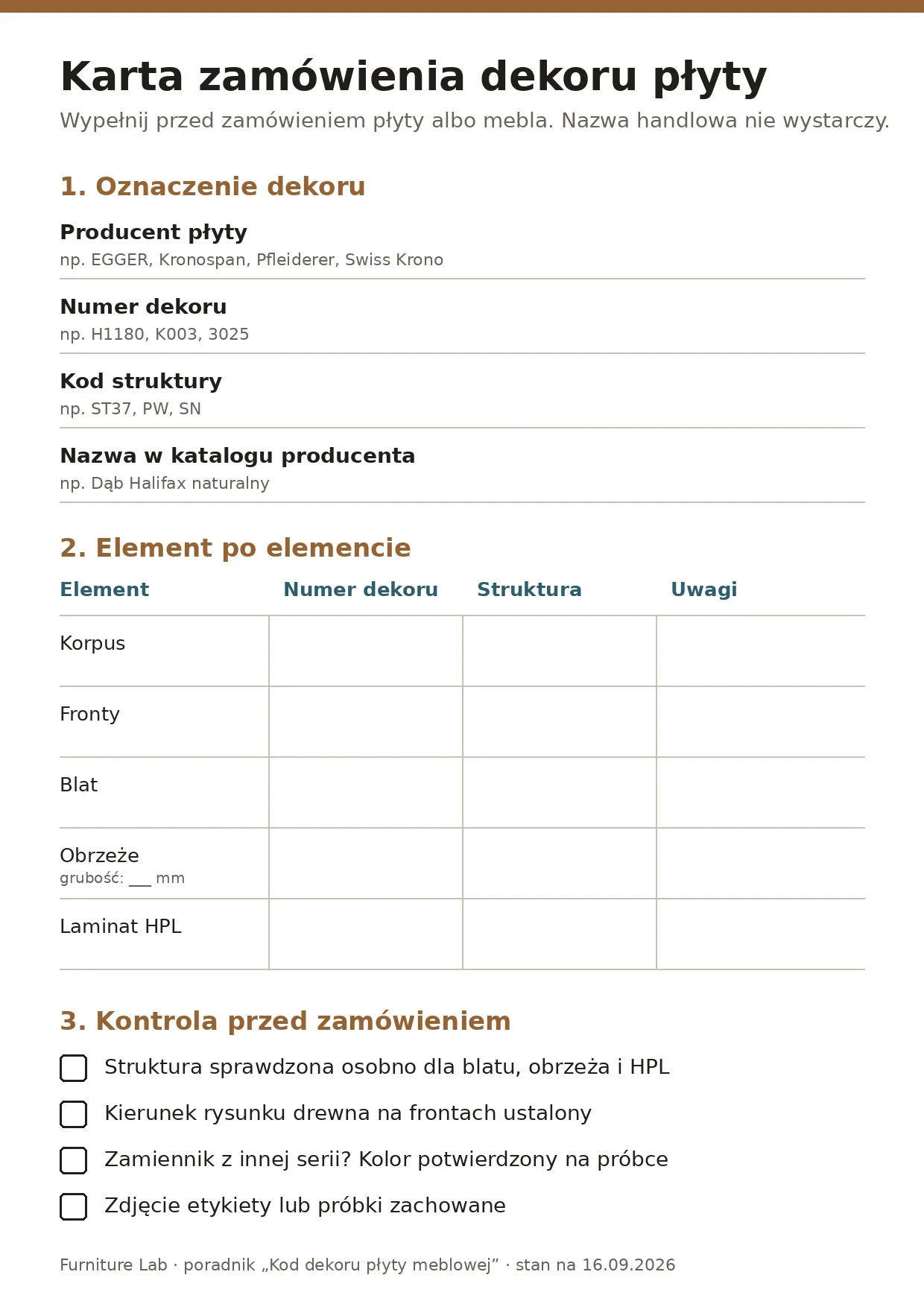
In the order, write the full decor designation: manufacturer, decor number, texture code and the name from the manufacturer's catalogue. Repeat these details separately for the carcass, fronts, worktop and edging. The name alone, for example "Sonoma oak", is not enough, because it has several numbers at different companies.
- Board manufacturer: EGGER, Kronospan, Pfleiderer, Swiss Krono or another.
- Decor number and texture: for example H1180 ST37, not "Halifax".
- Name from the manufacturer's catalogue: as a backup, to catch a typo in the number.
- Element by element: whether the worktop and edging have the same texture as the fronts, or a deliberately different one.
- Direction of the wood pattern: for wood-look decors, especially on fronts placed side by side.
- A photo of the label or sample: useful for a complaint and when you need to replace a part.
We collected the same fields in a printable card. Fill it in before ordering the board or furniture and keep it at hand when you place the order. You can also download the card and the diagram as an A4 PDF.
The code is also useful years later, when you need to replace a shelf or deal with a damaged edge. We cover that separately, in the article on how to mask a scratch or chip on laminate.
In the made-to-measure furniture range from Furniture Lab we offer laminated board in the decors Natural Halifax Oak, Matt White, Cashmere Grey, Dark Concrete and Lincoln Walnut. The name "Natural Halifax Oak" appears in the EGGER catalogue as H1180 ST37. A matching name alone does not settle the board manufacturer, though, just as "Sonoma oak" does not mean a single decor. The second material in the range is veneer: oiled oak, bleached ash and oiled American walnut. Veneer is natural wood, so it is described by species and finish, not by a decor number.
To see laminated board in finished furniture, look at the Fala Chest of Drawers, which has a default size of 160 × 45 × 78 cm and can be resized in 1 cm steps. You will find the other models on the made-to-measure chest of drawers page. If you want to ask about a decor before ordering, write through the contact form.
Frequently asked questions about decor codes
What does ST mean in an EGGER decor?
ST comes before the surface texture number in EGGER designations. The decor number tells you which pattern is printed, and ST with a number tells you what texture the board has: ST9 is Smoothtouch Matt, ST12 is Omnipore Matt and ST37 is Feelwood Rift. Some surfaces have other abbreviations, for example PM (PerfectSense Premium Matt).
What do PW, SN and PE mean on a Kronospan board?
These are Kronospan texture abbreviations. PW is Pure Wood, a texture inspired by lacquered veneer. SN is Super Natural, a linear texture with a matt-gloss effect. PE is Pearl, a grainy surface with a sand effect.
Are EGGER and Kronospan Sonoma oak the same decor?
No. Kronospan designates its decor with the number 3025, while H1145, described in accessory shops as "Sonoma oak Egger", is called Natural Bardolino Oak by EGGER. Ostermann lists Bardolino edging as a help for matching Kronospan 3025 SN, but recommends checking the colour on samples.
Does the same decor number always have the same texture?
No. On the K003 page Kronospan assigns the PW texture to laminated particleboard, HPL Standard laminate and door laminates, and the FP texture to worktops with a rounded edge and to HPL worktops. That is why you check the texture separately for each product.
Does edging that matches a board always have the same code?
Not always. In the Finish Match programme (North America) EGGER shows edging Q1180 RO for board H1180 ST37 and declares identical textures and decorative papers. The safest edging is the one the board manufacturer itself assigns to the decor. Confirm substitutes from other companies on a sample.
Where do I look for the decor code if I am buying finished furniture?
Ask the seller for the board manufacturer and the full decor designation, because the colour name in the furniture description is not enough. For a board or sample, you find the code on the manufacturer's decor page and on the shop product page. The EGGER page address contains the decor number and texture number, for example H1180_37.
Summary
You read a furniture board decor code in three steps: manufacturer, decor number, texture. The number tells you about the pattern, the texture about the feel, and the trade name, like "Sonoma oak", only describes them and differs between shops. Match edging and worktop by the full designation and confirm the colour on a sample.
Once you know which decor you are looking for, configure the Linea Shelf to the centimetre and check the price straight away. Production takes up to 10 working days, courier delivery across Poland is free and the furniture comes with a 24-month guarantee. You will find more articles about boards in the Materials and boards category and the whole range on the made-to-measure furniture page.
Sources (as of 16 September 2026)
- EGGER, decor pages: H1176 ST37 White Halifax Oak, H1180 ST37 Natural Halifax Oak, H1181 ST37 Tobacco Halifax Oak, H3176 ST37 Pewter Halifax Oak, H1145 ST10 Natural Bardolino Oak, W1000 ST9 Premium White, U960 ST9 Grey Onyx
- EGGER, textures and collections: textures and surfaces (PL), textures (EN), Decorative Collection 26+, Decors with changed availability 2020–23 (PDF), Finish Match System, North America
- Kronospan: texture glossary, K003 Gold Craft Oak (PL), K003 Gold Craft Oak (EN, textures by product), 3025 Light Vintage Oak
- Pfleiderer: R20128 Sonoma Oak, R20006 Sonoma Oak, R20031 Truffle Sonoma Oak
- Swiss Krono: D3025 OW Sonoma Oak (sklep.swisskrono.pl)
- Retail: Castorama, Dąb Craft złoty K003, Meblowo.eu, Kronospan 3025 SN Light Sonoma Oak, Ostermann, Kronospan 3025 SN and edging matching, meble.pl, description "Sonoma oak / Egger H1145"
How we prepared this article
We checked the decor and texture designations on 15 September 2026 and again on 16 September 2026 on the websites of the manufacturers EGGER, Kronospan and Pfleiderer and in the Swiss Krono online shop. The names used in the trade come from the product pages of shops and of the distributor Ostermann. The texture descriptions in the tables summarise the manufacturers' descriptions. We did not test samples and we do not judge shades. We do not give decor codes for the Furniture Lab range until we confirm the source of the board. If you notice an outdated code, write through the contact form and we will check it and correct the article.
About the author
Furniture for your wall, to the centimetre
See what you can design to measure, or go to the recommended page.
Read next
 Materials and boards
Furniture edge banding: which one to choose?
Furniture edge banding: 0.8 or 2 mm, ABS or PVC, PUR or laser? See tables from manufacturer data and a checklist for judging the edges of finished furniture.
25 min read
 Furniture care
How to clean laminate and veneer furniture
How to clean laminate and veneer furniture? A YES/NO table for 12 household products, based on EGGER, Kronospan and oil makers. Check before you wash a front.
23 min read
 Advice
How to choose furniture colour: sample test
How to choose furniture colour when a screen and a bulb alter a decor's shade? Test a sample at home in 9 steps: light, floor, upright and flat. PDF checklist.
27 min read